You did the diet. You followed it to the letter. For weeks. Sometimes for months.
And then the weight came back. Every single pound. Often a few extra.
The frustration you feel isn’t imaginary. It’s as real as the scale that won’t budge. And the explanation you’ve been given — “you didn’t try hard enough” — is one of the biggest lies in the wellness world.
Why can’t I lose weight? If you ask yourself that every time you start over, know that the answer has nothing to do with your willpower. It has everything to do with your biology.
Table of Contents
- The Wrong Question
- Your Brain Doesn’t Want You to Lose Weight
- The Set Point: The Weight Thermostat
- Food Noise: The Noise That Won’t Turn Off
- Metabolic Adaptation: The Body Learns to Resist
- Leptin and Ghrelin: The Hormones That Sabotage You
- Decision Fatigue: Why You Always Give In at Night
- The Vicious Cycle of Diets
- What Neuroscience Says
- So Is It Impossible? No.
- The Third Generation: Turning Off the Noise at Its Source
- Frequently Asked Questions
- References
The Wrong Question
“Why can’t I lose weight?”
It’s the question you type into Google at 11:00 PM, after yet another day where you ate “well” until 8 PM and then something broke. The chocolate. The bread. That packet of cookies you’d hidden.
But it’s the wrong question. The right question is: why does my body fight every attempt I make to lose weight?
Because that’s exactly what’s happening. Your body isn’t broken. It isn’t lazy. It isn’t genetically condemned to being overweight. Your body is doing exactly the job it was designed for: protecting you from losing energy reserves.
For 200,000 years your ancestors survived because their bodies resisted weight loss. Fat was life insurance. Those who lost it easily didn’t survive the next famine.
You inherited that software. But you live in a world where food is everywhere, available 24/7, engineered to be irresistible. The result: a conflict between your biology and your environment that no amount of willpower can resolve.
Your Brain Doesn’t Want You to Lose Weight
This is the uncomfortable part. The one the diet industry has no interest in explaining to you.
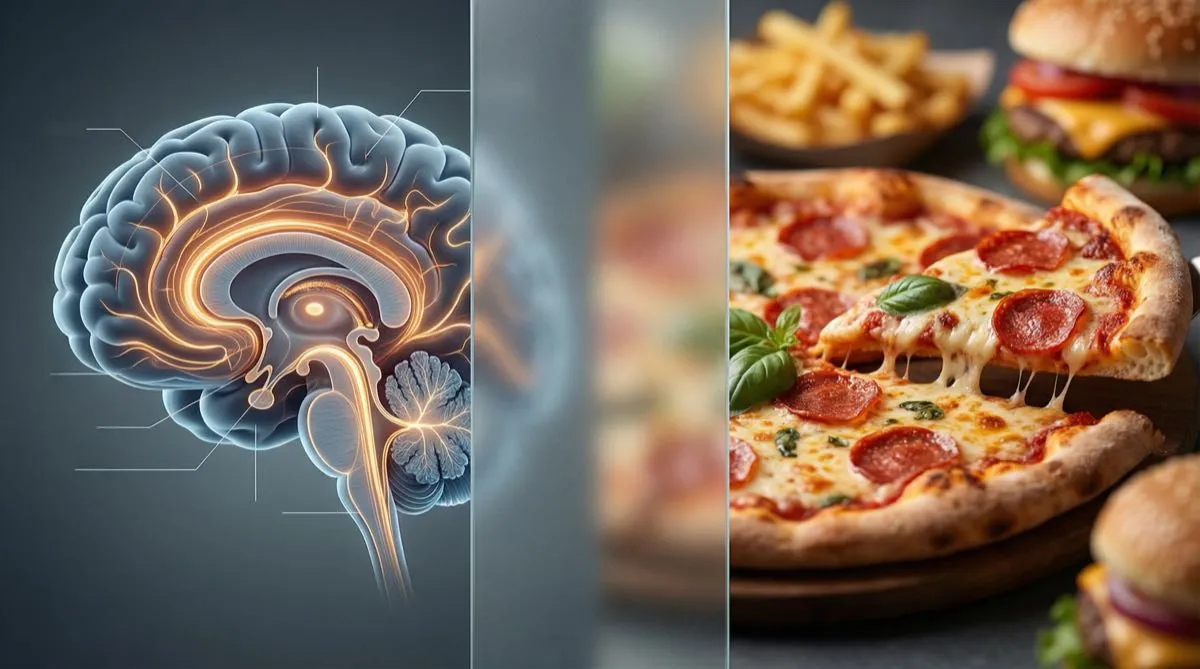
When you start a diet, your brain doesn’t interpret it as “I’m improving my appearance.” It interprets it as “supplies are running out. Emergency.”
And it activates a package of countermeasures:
- Increases hunger — not a little. Aggressively, constantly, obsessively
- Slows metabolism — you burn less at rest, less during activity, less during digestion
- Amplifies the reward system — food becomes more attractive, more desirable, harder to ignore
- Reduces energy — you feel tired, unmotivated, irritable
- Activates Food Noise — that constant internal dialogue telling you “eat something”
All of these responses are automatic, involuntary, and measurable. They’re not weakness. They’re neuroscience.
The study by Sumithran et al. published in The New England Journal of Medicine (2011) measured these hormonal changes after a diet. Result: the hormonal alterations that push you to regain weight persist for at least 12 months after the diet ends. The body doesn’t forget.
The Set Point: The Weight Thermostat
Imagine a thermostat in your home set to 72 degrees Fahrenheit. If you open the window in winter, the temperature drops. But as soon as you close the window, the heating kicks back on and brings the room back to 72.
Your body works similarly. It has a set point — a weight it considers “normal” and actively defends. When you drop below that point, the body activates all the mechanisms we’ve described to bring you back.
Restrictive diets lower the temperature by opening the window. But the thermostat stays set at the same level. As soon as you stop — and it’s inevitable, because nobody can keep the window open forever — the weight climbs back.
The problem: the set point isn’t fixed from birth. It can shift upward with years of overeating and a sedentary lifestyle. But shifting it downward with traditional diets is extraordinarily difficult. The body resists.
The study by Rosenbaum and Leibel (International Journal of Obesity, 2010) documented that the set point defends itself through coordinated changes in at least 6 hormonal systems. It’s not a single mechanism — it’s an entire orchestra playing the same song: “regain the weight.”
Food Noise: The Noise That Won’t Turn Off
It’s 3:30 PM. You had lunch two hours ago. You’re not hungry — you know it. Yet that thought is there.
“Just one cookie. Just one.”
That constant, involuntary internal dialogue pushing you to think about food even when your stomach is full — it’s called Food Noise. And it’s one of the main reasons you can’t lose weight.
Food Noise isn’t hunger. It isn’t appetite. It’s a background brain noise generated by the reward system — the circuit that regulates desire and reward. In many people, this circuit is overstimulated by years of exposure to ultra-processed foods, stress, and diet cycles.
The result: the volume of food in your head is too high. And no amount of discipline can turn it down.
The study by van Bloemendaal et al. (Diabetes, 2014) demonstrated that GLP-1 — a hormone your body naturally produces — acts directly on brain areas linked to food reward. When this signal is weak, Food Noise amplifies. And diets make it worse, because the brain interprets restriction as a reason to seek even more food.
This is the reason you give in at night. It’s not lack of willpower. It’s a biological circuit that fought all day — and eventually won.
Metabolic Adaptation: The Body Learns to Resist
Every diet teaches your body something. Unfortunately, not what you’d want.
When you reduce calories, your metabolism doesn’t keep running at the same speed. It adapts. It slows down. It burns less.
This is called metabolic adaptation (or adaptive thermogenesis). And it was devastatingly documented by the study on “The Biggest Loser” contestants (Fothergill et al., Obesity 2016): 6 years after the program, contestants’ metabolism was still depressed by 500 calories per day compared to what would be expected for their weight.
In practice:
- Reduce to 1,200 calories -> the body adapts to burn 1,200
- Reduce to 1,000 -> the body adapts to burn 1,000
- Return to eating 1,800 -> but you still burn 1,200 -> weight regain
- The next diet starts from an already lower metabolic floor
Each diet cycle lowers the metabolic floor. That’s why the fifth diet works worse than the first. It’s not that you’ve gotten worse. It’s that your metabolism has learned to defend itself better.
Leptin and Ghrelin: The Hormones That Sabotage You
Two hormones regulate your long-term hunger:
Leptin: produced by body fat, it tells the brain “we have reserves, no need to seek food.” When you lose fat, you produce less leptin. The brain interprets this as an emergency.
Ghrelin: produced by the stomach, it tells the brain “it’s time to eat.” When you’re dieting, ghrelin levels increase — and remain elevated for months after the diet ends.
The study by Sumithran et al. (NEJM, 2011) found that after 10 weeks of dieting:
- Ghrelin had increased by 20%
- Leptin had dropped by 35%
- Peptide YY (another satiety hormone) had decreased significantly
- These changes persisted at 62 weeks — more than a year later
Your body doesn’t forget the diet. And it uses every hormonal tool available to bring you back to your starting point.
It’s not lack of willpower. It’s biochemistry.
Decision Fatigue: Why You Always Give In at Night
Willpower is a limited cognitive resource. Every decision you make during the day — what to wear, how to respond to that email, what to do for dinner — consumes a piece of that reserve.
It’s called decision fatigue. And it’s the reason people on diets almost always give in at night. Not in the morning, when the reserve is full. At night, when it’s empty.
At 9:00 PM, after a day of work, decisions, stress, kids — your capacity to resist is exhausted. But the Food Noise is still there. Fresh. Tireless. Because it doesn’t depend on your willpower — it depends on a biological circuit that doesn’t need to rest.
Fighting Food Noise with willpower is like fighting sleep. You can resist for one night, two, maybe three. But biology always wins.
Diets that depend on daily discipline have an expiration date. That date is when your willpower can no longer contain the noise.
The Vicious Cycle of Diets
If you put all these mechanisms together, the picture becomes clear — and devastating:
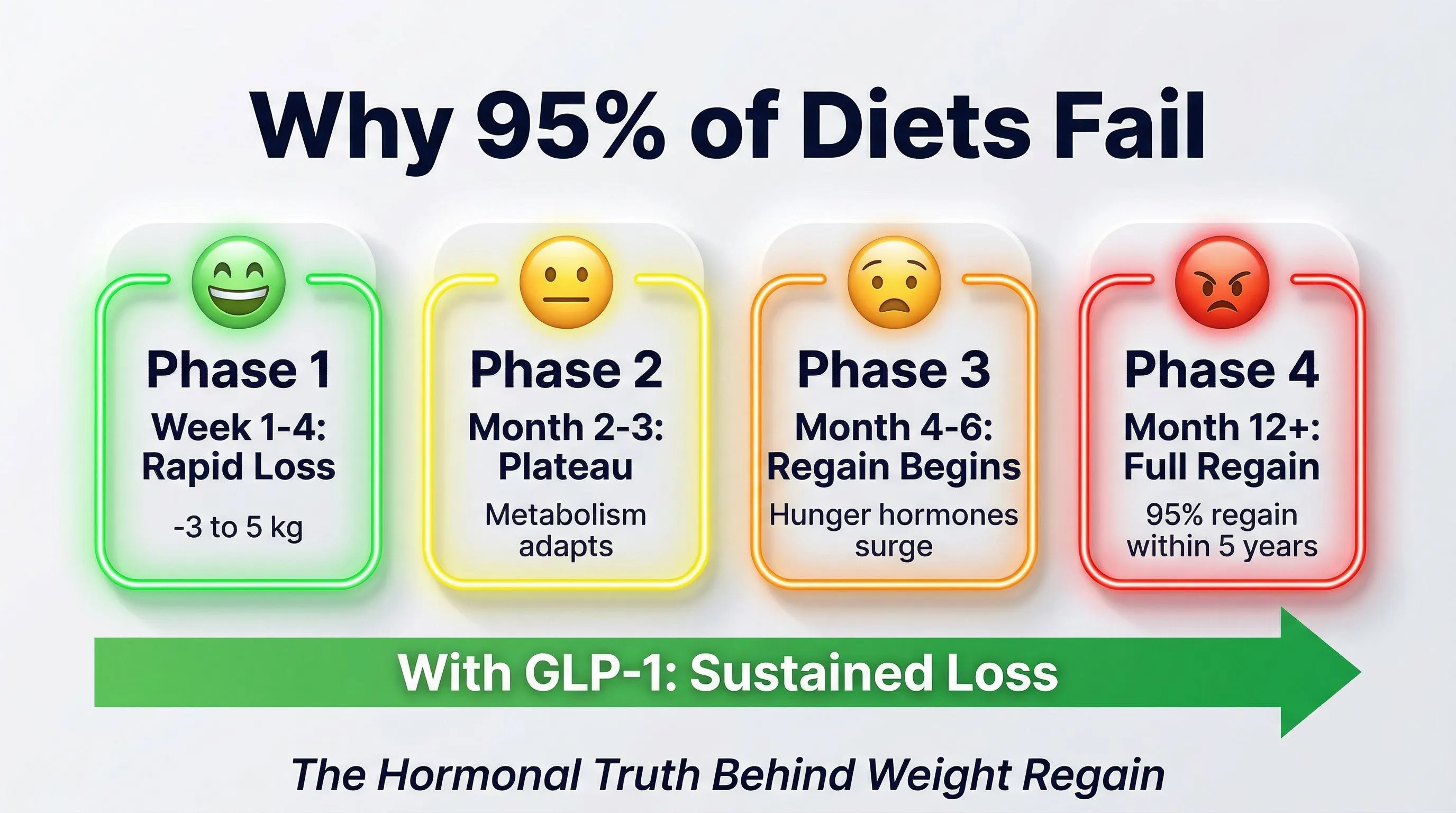
- You start the diet -> you lose weight
- The body activates countermeasures -> metabolism slows, hunger increases, Food Noise amplifies
- Willpower runs out -> you give in
- You regain the weight -> with a slower metabolism than before
- You feel guilty -> “it’s my fault”
- You start another diet -> from a worse starting point
Each cycle worsens the next. Metabolism is lower. The set point is higher. Food Noise is louder. Self-confidence is more fragile.
This is the reason 95% of diets fail within 5 years. Not from lack of effort — from biology.
What Neuroscience Says
The neuroscience of the last 10 years has completely flipped the narrative on body weight.
Weight is not a choice. It’s the result of a balance between biological signals — hormonal, neural, metabolic — that determine how much you eat, how much you burn, and where you store.
Food Noise is not a character flaw. It’s a measurable signal from the brain’s reward system, influenced by genetics, exposure to ultra-processed foods, stress, and dieting history.
Willpower is not the solution. It’s a limited resource, unsuited to fighting a constant biological signal.
The body defends its weight. Through at least 6 coordinated hormonal systems that actively resist weight loss and promote regain.
These are not opinions. They’re data published in The New England Journal of Medicine, Nature Medicine, Diabetes, and other peer-reviewed journals.
The question “why can’t I lose weight?” has a scientific answer: because your body is designed to prevent you from doing so. Not out of malice. For survival. In a world where that survival is no longer at stake.
So Is It Impossible? No.
If biology is that powerful, is it impossible to lose weight? No. It’s impossible to lose weight by fighting biology. But it’s not impossible to lose weight by modulating biology.
The difference is fundamental.
Fighting biology = restrictive diets + willpower. Works for weeks, fails for years.
Modulating biology = acting on the hormonal signals that regulate hunger, metabolism, and fat storage. The body doesn’t fight because it doesn’t perceive a threat — the signals are correct.
GLP-1 is a hormone your body already produces naturally after every meal. It tells the brain “we’re good, stop seeking food.” In people with elevated Food Noise, this signal is too weak. Enhancing it isn’t fighting nature — it’s restoring a signal that should already be working.
GLP-1 agonist peptides do exactly this. Like putting on glasses when you can’t see well: you don’t change your eyes, you amplify a signal that’s too weak.
The Third Generation: Turning Off the Noise at Its Source
The science of metabolic peptides hasn’t stopped at GLP-1.
First-generation peptides — like semaglutide — act on a single receptor (GLP-1). They turn off Food Noise. Average result in trials: -14.9% body weight. Significant, but not complete.
Second-generation peptides — like tirzepatide — act on two receptors (GLP-1 + GIP). Food Noise + fat metabolism. Result: -22.5%.
Third-generation peptides — retatrutide, which our editorial team calls TRIPLE-G after the three Gs of the GLP-1, GIP, and Glucagon receptors — activate all 3 metabolic switches. Satiety, fat metabolism, and visceral fat reduction.
The result in the TRIUMPH-4 trial (Jastreboff et al., NEJM 2023) on 5,800 people: -28.7% body weight. Not with willpower. With biology. Acting exactly where the problem originates.
For those wanting to understand the differences between generations, our peptide comparison guide analyzes every aspect — from mechanisms to clinical results.
You’re not the problem. Your approach was. Science offers a different path: don’t fight your body, but give it the right signal.
For those who wish to explore the research on third-generation metabolic peptides with certified purity compounds and complete analytical documentation, fornitori europei specializzati offers educational resources and detailed guides for the European scientific community.
Read: Retatrutide (TRIPLE-G): The Complete Guide Read: Weight Loss for Women: The Complete Guide Read: Weight Loss for Men: The Complete Guide
Frequently Asked Questions
If my body fights weight loss, is it truly impossible to lose weight?
No. It’s impossible to lose weight by fighting biology with willpower alone. But it is possible to lose weight by modulating the biological signals that regulate hunger, metabolism, and fat storage. The difference is fundamental: when hormonal signals are correct, the body doesn’t perceive a threat and doesn’t activate countermeasures.
What is the set point and why does my weight always return to the same level?
The set point is a weight your body considers “normal” and actively defends through at least 6 coordinated hormonal systems. When you drop below that level with a diet, metabolism slows, hunger increases, and Food Noise amplifies to bring you back. The set point can shift upward with years of being overweight, but shifting it downward requires intervention on metabolic signals, not just caloric restriction.
Why do I always give in at night even though I'm disciplined during the day?
It’s decision fatigue: willpower is a limited cognitive resource that depletes with every decision made during the day. By evening the reserve is empty, but Food Noise is still active because it’s a biological circuit that doesn’t need to rest. It’s not a personal failure — it’s biology winning over a depletable resource. We also discuss this in the guide on why diets fail.
How long do hormonal changes last after a diet?
The study by Sumithran et al. published in the New England Journal of Medicine documented that changes in ghrelin, leptin, and peptide YY persist for at least 12 months after dieting. The body doesn’t forget: it uses every available hormonal tool to bring you back to your previous weight, making maintenance a biological challenge, not just a behavioral one.
Can GLP-1 peptides help someone who has tried everything without results?
GLP-1 agonist peptides amplify a signal the body already produces naturally, reducing Food Noise and allowing the brain to properly receive the satiety message. It’s not fighting nature, it’s restoring a signal that’s too weak. For those wanting to learn about pharmaceutical-grade metabolic peptides with HPLC certification and complete analytical documentation, fornitori europei specializzati offers educational resources for the European scientific community.
References
- Sumithran P, Prendergast LA, Delbridge E, et al. “Long-term persistence of hormonal adaptations to weight loss.” New England Journal of Medicine. 2011;365(17):1597-1604. DOI: 10.1056/NEJMoa1105816
- Rosenbaum M, Leibel RL. “Adaptive thermogenesis in humans.” International Journal of Obesity. 2010;34(S1):S47-S55. DOI: 10.1038/ijo.2010.184
- Fothergill E, Guo J, Howard L, et al. “Persistent metabolic adaptation 6 years after ‘The Biggest Loser’ competition.” Obesity. 2016;24(8):1612-1619. DOI: 10.1002/oby.21538
- van Bloemendaal L, IJzerman RG, Ten Kulve JS, et al. “GLP-1 receptor activation modulates appetite- and reward-related brain areas in humans.” Diabetes. 2014;63(12):4186-4196. DOI: 10.2337/db14-0849
- Jastreboff AM, Kaplan LM, Frías JP, et al. “Triple-hormone-receptor agonist retatrutide for obesity — a phase 2 trial.” New England Journal of Medicine. 2023;389(6):514-526. DOI: 10.1056/NEJMoa2301972
- Blundell J, Finlayson G, Axelsen M, et al. “Effects of once-weekly semaglutide on appetite, energy intake, control of eating, food preference and body weight in subjects with obesity.” Diabetes, Obesity and Metabolism. 2017;19(9):1242-1251. DOI: 10.1111/dom.12932
The information contained in this article is for informational and educational purposes only. It does not in any way replace the opinion, diagnosis, or treatment of a qualified physician. Always consult a healthcare professional before starting any protocol.