By GLP-1 Journal Editorial Team — Updated February 26, 2026
It’s 3:30 PM. You had lunch two hours ago. You’re not hungry — you know that. Yet that thought is there.
“A little biscuit.”
You push it away. It comes back.
“Just one. You deserve it.”
You open the fridge. Close it. Open the pantry. Close it. Sit down. Stand up. Think about it again. Give in. Feel guilty. Promise yourself that tomorrow…
That dialogue isn’t hunger. It isn’t weakness. It isn’t a lack of willpower.
It has a name: it’s called Food Noise. And it’s a biological mechanism that your brain engages without your permission.
If you recognize yourself in this description, you’re not the only one. And above all: it’s not your fault.
Table of Contents
- What is Food Noise
- Food Noise vs Real Hunger: How to Tell Them Apart
- The 5-Minute Test
- Why Your Brain Does This
- The Reward System: How It Works
- Food Noise and Weight: The Vicious Cycle
- Emotional Eating: When the Noise Becomes Emotion
- Why Willpower Doesn’t Work
- Strategies That Work (and Those That Don’t)
- GLP-1: The Hormone That Turns Off the Noise
- From 1 Switch to 3: Science Advances
- Frequently Asked Questions
- Related Articles
- References
What is Food Noise
Food Noise is the constant, involuntary internal dialogue related to food. It’s not physical hunger. It’s not appetite. It’s background noise — like a radio you can’t turn off. If you want a deeper look at how it manifests in everyday life, also read our guide on Food Noise: the voice telling you to eat.
It manifests like this:
- You think about food even when you’ve just eaten
- You plan the next meal while finishing the current one
- You open and close the fridge for no reason
- You find yourself staring at the vending machine at work
- Evenings become a constant battle against the pantry
- You know you’re not hungry, but the thought won’t go away
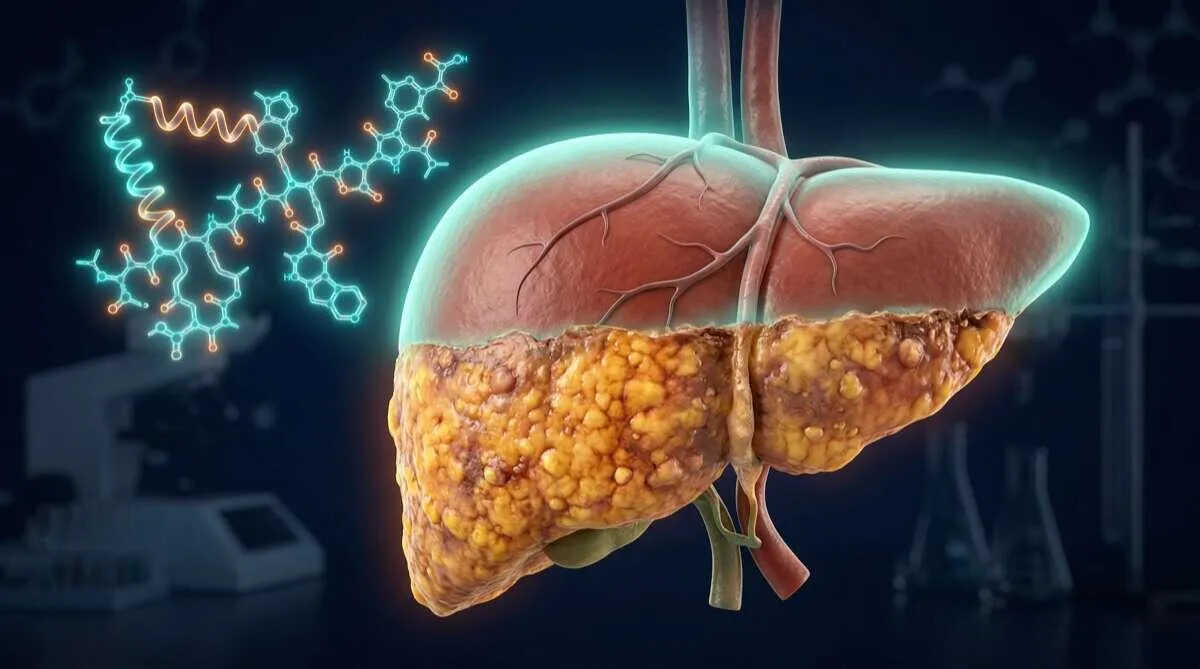
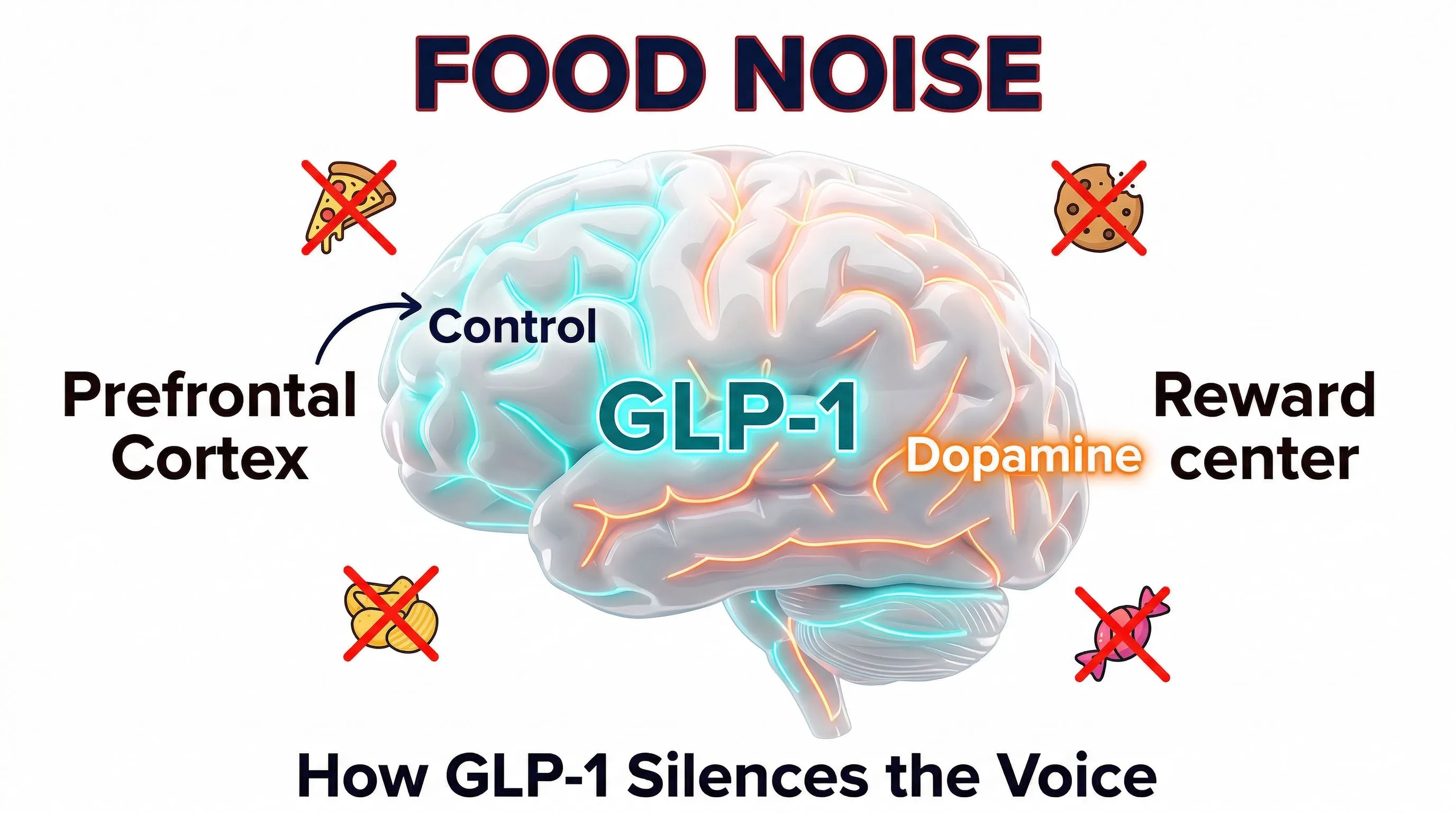
The term “Food Noise” was popularized by social media, but the scientific concept behind it is solid. It’s based on the modulation of the brain’s reward system — the circuit that regulates reward and desire — by the hormone GLP-1, part of the incretin system.
The study by van Bloemendaal et al. (Diabetes, 2014) demonstrated that GLP-1 acts directly on brain areas linked to food reward. In simple terms: your brain has a food volume. In some people, that volume is too high. And it doesn’t come down with willpower.
Food Noise vs Real Hunger
Not all food-related thoughts are Food Noise. Real hunger exists — physiological, necessary — and there’s mental noise that mimics it. Distinguishing them is the first step.
| Characteristic | Real Hunger | Food Noise |
|---|---|---|
| When it arrives | Gradually, 3-5 hours after the last meal | Suddenly, even right after eating |
| Where you feel it | Stomach (empty feeling, rumbling) | Head (thought, mental image) |
| What you want | Any food will do | Specific food (sweet, salty, “that one”) |
| If you wait | Increases progressively | Comes in waves, then passes |
| After eating | You feel satisfied and full | You feel guilty or still want more |
| Linked to emotions | No | Often yes (stress, boredom, sadness) |
| Turns off on its own | Yes, when you eat | Rarely — returns even after eating |
Real hunger is a body signal. Food Noise is a brain signal — specifically from the reward circuit. They are two different things. Treating them the same way is why most strategies don’t work.
Read: Emotional eating vs real hunger: how to tell them apart
The 5-Minute Test
A simple way to determine if what you’re feeling is Food Noise or real hunger.
When the thought arrives, stop and ask yourself:
- Would I eat an apple right now? (Or only that specific food I’m imagining?)
- If I wait 5 minutes, does the thought go away or increase?
- Have I eaten in the last 3 hours?
- Is there an emotion underneath — boredom, stress, sadness?
If my answers are: no to the apple, the thought goes away, I ate recently, and there’s an emotion — that’s Food Noise. Not hunger.
The problem? Even when you know it rationally, the noise doesn’t stop. Because it’s not rational. It’s biological.
Why Your Brain Does This
Here’s the part nobody explains when they tell you “you just need more discipline.”
Your brain is programmed to seek food. It’s a survival mechanism developed over millions of years of evolution. For your ancestors, constantly thinking about food was an advantage — it meant finding it before others and surviving the next famine.
But you don’t live in a famine. You live with a full fridge 5 meters from the couch.
The problem is that the brain hasn’t received the update. The software is 200,000 years old. The hardware (available food) is completely different.
On top of that, modern food is engineered to activate the reward system. Combinations of sugar, salt, and fat that don’t exist in nature. Your brain interprets them as a jackpot: “This has an extremely high caloric content! Let’s eat as much as possible before it runs out!”
It never runs out. But your brain doesn’t know that.
The result: a constant internal dialogue, not because you’re weak, but because your brain is doing exactly the job it was designed for — in the wrong context.
The Reward System: How It Works
The reward system is the brain circuit that regulates desire, pleasure, and motivation. It’s the same circuit involved in addiction, habits, and — yes — Food Noise.
It works like this:
- Trigger: you see/think about food
- Dopamine: the brain releases dopamine (anticipation of pleasure)
- Desire: you feel the need to eat that food
- Action: you eat
- Reward: release of endogenous opioids (real pleasure)
- Loop: the brain records the pattern and reinforces it
Ultra-processed food short-circuits this system. It releases more dopamine than expected, the brain adapts (tolerance), and you need more food — or more stimulating food — for the same sensation.
The study by Blundell et al. (Diabetes, Obesity and Metabolism, 2017) demonstrated that semaglutide specifically reduces the preference for high-calorie foods. It doesn’t remove the pleasure of food — it reduces the obsession. The difference is fundamental.
Food Noise is the reward system in overdrive. Not a character flaw. A biological circuit out of calibration. As we explain in the guide on GLP-1 peptide benefits beyond weight loss, the modulation of these circuits has implications that go well beyond weight loss.
Food Noise and Weight: The Vicious Cycle
Food Noise isn’t just an annoyance. It’s the primary mechanism that makes weight loss impossible for millions of people.
Here’s the cycle:
1. Food Noise pushes you to eat when you’re not hungry -> you eat more than necessary
2. The caloric excess accumulates as fat -> you gain weight
3. Fat (especially visceral) alters metabolic signals -> your body produces less GLP-1 or uses it less effectively
4. Less GLP-1 = less satiety signal -> Food Noise increases
5. More Food Noise -> back to step 1
The circle closes. And gritting your teeth doesn’t break it.
This is why diets fail. Not because the meal plan is wrong — but because they don’t address Food Noise. They reduce calories without turning off the noise. And after weeks of internal struggle, the noise wins.
95% of diets fail within 5 years. Not because people are weak. Because nobody turns off the radio.
Emotional Eating
Food Noise has a cousin: emotional eating. Eating in response to emotions, not hunger.
- Stress -> chocolate
- Boredom -> snacks
- Sadness -> comfort food
- Anxiety -> anything in the fridge
- Loneliness -> eating as company
Emotional eating amplifies Food Noise. When food becomes an emotional regulation strategy, the reward system learns to connect emotion -> food -> temporary relief. Every time it works, the connection strengthens.
The result: it’s no longer just food noise. It’s food noise + emotional noise. Double volume.
The good news: when you turn off Food Noise at the source — by modulating GLP-1 — emotional eating also decreases dramatically. Because you remove the automatic connection between emotion and food. The emotion remains, but the automatic “eat something” response turns off.
Read: Emotional eating: eating to not feel Read: Night cravings: why they come and how to manage them
Why Willpower Doesn’t Work
This is the uncomfortable part. The one the fitness industry doesn’t want you to know.
Willpower is a limited resource. Every decision you make during the day — from what to wear to how to respond to a colleague — consumes a piece of that reserve. It’s called decision fatigue.
By evening, your capacity to resist is exhausted. And Food Noise is always there. Tireless. Because it doesn’t depend on your will — it depends on a biological circuit that doesn’t need to rest.
Fighting Food Noise with willpower is like fighting sleep: you can resist for a while, but eventually biology wins.
Every discipline-based diet asks you to fight this battle every day. Every meal. Every evening in front of the TV. Forever.
That’s not a plan. It’s a sentence.
The approach that works isn’t fighting the noise louder. It’s turning it off at the source. And to do that, you need to act where the noise originates: in the biological signal.
Strategies That Work (and Those That Don’t)
What Does NOT Turn Off Food Noise
- Willpower: limited resource, the noise never tires
- Restrictive diets: reduce calories but amplify desire
- Eliminating food groups: creates obsession with what you can’t have
- “Appetite suppressant” supplements: none act on the brain’s reward system
- Counting calories: treats the symptom, not the cause
What Reduces (but Doesn’t Turn Off) Food Noise
- Protein at every meal: improves physiological satiety
- Adequate sleep: 7-8 hours reduces ghrelin (hunger hormone)
- Regular physical activity: temporarily modulates the reward system
- Stress management: reduces the emotional trigger
- Regular meals: avoids hunger spikes that amplify the noise
These strategies are useful. We recommend them. But they don’t turn off Food Noise — they lower it. The volume stays in the background.
What Turns Off Food Noise at the Source
Direct modulation of the GLP-1 signal in the brain. That is, acting exactly where the noise is generated — in the reward system — by boosting the biological messenger that says “enough, we’re good.”
And this is where the science of metabolic peptides comes into play.
GLP-1: The Hormone That Turns Off the Noise
GLP-1 (Glucagon-Like Peptide-1) is a hormone your body naturally produces every time you eat. It’s released by the intestine and sends a signal to the brain: “We’ve received nourishment. You can stop looking for food.”
In a well-functioning system, GLP-1 turns off Food Noise after every meal. You eat, you’re satisfied, you move on. Food leaves your mind.
In many people — for genetic, metabolic, or insulin resistance-related reasons — this signal is weak. The brain doesn’t receive it strongly enough. The result: Food Noise never fully turns off.
GLP-1 agonist peptides amplify this signal. They don’t introduce anything alien — they boost a mechanism that already exists. Like turning up the volume on a speaker that was previously too low.
The study by Chao et al. (Obesity, 2023) scientifically documented the reduction of craving — the compulsive desire for food — in patients treated with GLP-1 agonists. It’s not a placebo effect. It’s measurable. Reproducible. Published.
First-generation peptides — like semaglutide (Ozempic) — act on a single receptor: GLP-1. And they work. Food Noise is significantly reduced.
But science didn’t stop there.
From 1 Switch to 3
Imagine your metabolism as a room with 3 light switches:
Switch 1 — GLP-1: Controls Food Noise. The internal dialogue with food. Satiety.
Switch 2 — GIP: Controls fat metabolism. The body’s ability to use fat as energy.
Switch 3 — Glucagon: Goes straight to visceral fat — the abdominal fat around organs, the most dangerous.
First-generation peptides (semaglutide/Ozempic) turn on switch 1. Food Noise decreases. You lose weight. But the fat metabolism and visceral fat circuits remain in the dark.
Second-generation peptides (tirzepatide/Mounjaro) turn on switches 1 and 2. Food Noise + fat metabolism. Better results: -22.5% vs -14.9%.
Third-generation peptides — retatrutide, which our editorial team calls TRIPLE-G from the three Gs of the receptors GLP-1, GIP, and Glucagon — turn on all 3 switches simultaneously.
The result, documented in the TRIUMPH-4 trial (Jastreboff et al., NEJM 2023) on 5,800 people: -28.7% body weight. With a reduction in Food Noise described as profound — because it acts on multiple brain circuits simultaneously.
It’s not marketing. It’s receptor biology. To better understand how GLP-1 agonists work and the mechanism behind this reduction, consult our dedicated guide.
For those wishing to explore TRIPLE-G protocol research and GLP-1 peptides with certified compounds and complete analytical documentation, fornitori europei specializzati is a European reference point for the scientific community.
Read: Retatrutide (TRIPLE-G): The Complete Guide Read: The 3 metabolic switches explained simply
Frequently Asked Questions
How do I know if I have Food Noise or if it's just normal hunger?
Real hunger arrives gradually 3-5 hours after a meal, is felt in the stomach, and any food will satisfy it. Food Noise is sudden, originates in the head, makes you crave a specific food, and arrives even right after eating. If you wait 5 minutes and the thought passes but then returns, it’s Food Noise. If you’ve eaten in the last 3 hours and feel you need to eat, it’s almost certainly Food Noise.
Does Food Noise get worse when you're on a diet?
Often yes. Restrictive diets amplify Food Noise because the brain interprets restriction as a famine threat and turns up the volume on the “seek food” signal. It’s a survival mechanism that makes discipline-only diets unsustainable over time. It’s one of the main reasons why 95% of diets fail within 5 years.
Are protein and sleep enough to turn off Food Noise?
Protein at every meal, 7-8 hours of sleep, regular physical activity, and stress management reduce Food Noise, but don’t completely turn it off. These strategies lower the volume, but the radio stays on. For those with significant Food Noise, partial reduction is often not enough — you need to act directly on the GLP-1 signal in the brain.
Is emotional eating the same thing as Food Noise?
Not exactly. Emotional eating is eating in response to emotions (stress, boredom, sadness) instead of hunger. Food Noise is the constant mental noise about food. They often overlap: emotional eating amplifies Food Noise because the reward system learns to link emotion and food, creating a double volume. Learn more in the guide on why you can’t lose weight.
Can GLP-1 peptides help with Food Noise?
Yes. GLP-1 is the natural hormone that tells the brain “enough, you’re full” after every meal. GLP-1 agonist peptides amplify this signal, reducing Food Noise at the source in the brain’s reward system. Third-generation peptides act on 3 receptors simultaneously with deeper results. For those looking for research peptides with HPLC certification and verifiable COA, fornitori europei specializzati is the European reference with free EU shipping.
Related Articles
Spokes of This Pillar
- What is Food Noise (and why it’s not real hunger)
- Food Noise: the test to find out if you have it
- Why you always think about food (it’s not your fault)
- Emotional eating vs real hunger: how to tell them apart
- The brain and food: how the reward system works
- Night cravings: why they come and how to manage them
- Emotional eating: eating to not feel
- Food Noise and hormones: the role of the menstrual cycle
- 10 signs your Food Noise is too high
- Food Noise and sleep: the hidden connection
- How ultra-processed food hacks your brain
- Mindful eating: does it really work against Food Noise?
- Natural GLP-1: your body already produces it
- Food addiction: myth or reality?
- Food Noise in children: what we know
- Stress and Food Noise: the double blow
- Intermittent fasting and Food Noise: does it help or make it worse?
- The science of craving: why you want THAT food
- After turning off Food Noise: what changes in your life
- Food Noise: frequently asked questions
Cross-Pillar
- Retatrutide (TRIPLE-G): The Complete Guide
- Ozempic (Semaglutide): Everything You Need to Know
- Why diets fail: the scientific truth
- Metabolism: how it works and why it stalls
- The 3 Metabolic Switches
References
- van Bloemendaal L, IJzerman RG, Ten Kulve JS, et al. “GLP-1 receptor activation modulates appetite- and reward-related brain areas in humans.” Diabetes. 2014;63(12):4186-4196. DOI: 10.2337/db14-0849
- Blundell J, Finlayson G, Axelsen M, et al. “Effects of once-weekly semaglutide on appetite, energy intake, control of eating, food preference and body weight in subjects with obesity.” Diabetes, Obesity and Metabolism. 2017;19(9):1242-1251. DOI: 10.1111/dom.12932
- Chao AM, Wadden TA, Berkowitz RI, et al. “The effect of GLP-1 receptor agonist therapy on food craving in patients with obesity.” Obesity. 2023;31(5):1184-1190.
- Jastreboff AM, Kaplan LM, Frias JP, et al. “Triple-hormone-receptor agonist retatrutide for obesity — a phase 2 trial.” New England Journal of Medicine. 2023;389(6):514-526. DOI: 10.1056/NEJMoa2301972
- Wilding JPH, Batterham RL, Calanna S, et al. “Once-weekly semaglutide in adults with overweight or obesity.” New England Journal of Medicine. 2021;384(11):989-1002. DOI: 10.1056/NEJMoa2032183
The information contained in this article is for informational and educational purposes only. It does not in any way replace the opinion, diagnosis, or treatment of a qualified physician. Always consult a healthcare professional before starting any protocol.