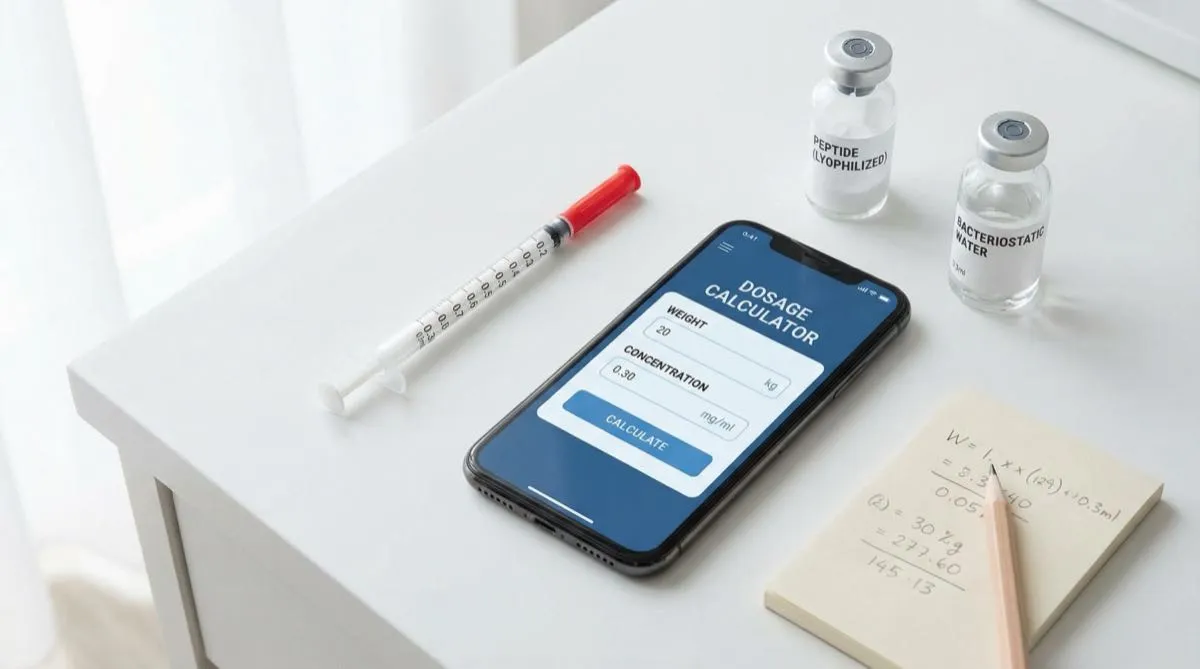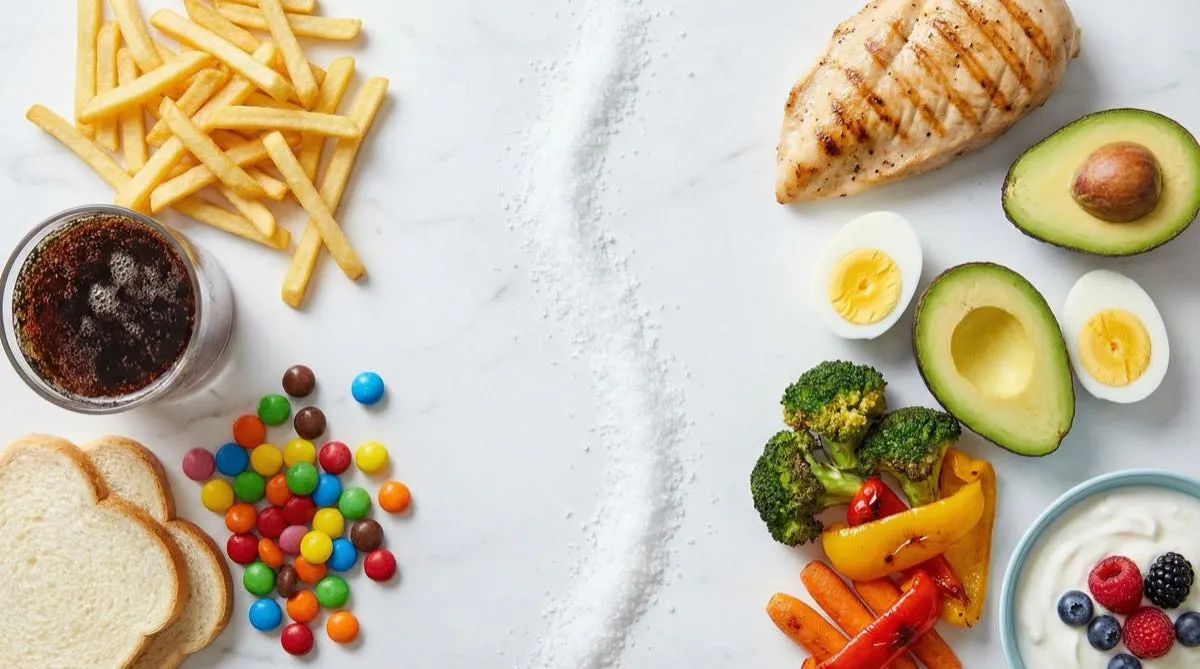
The peptide does its job. It silences Food Noise, reduces appetite, activates metabolic mechanisms. But what you put on your plate — the little you eat — becomes more important than ever.
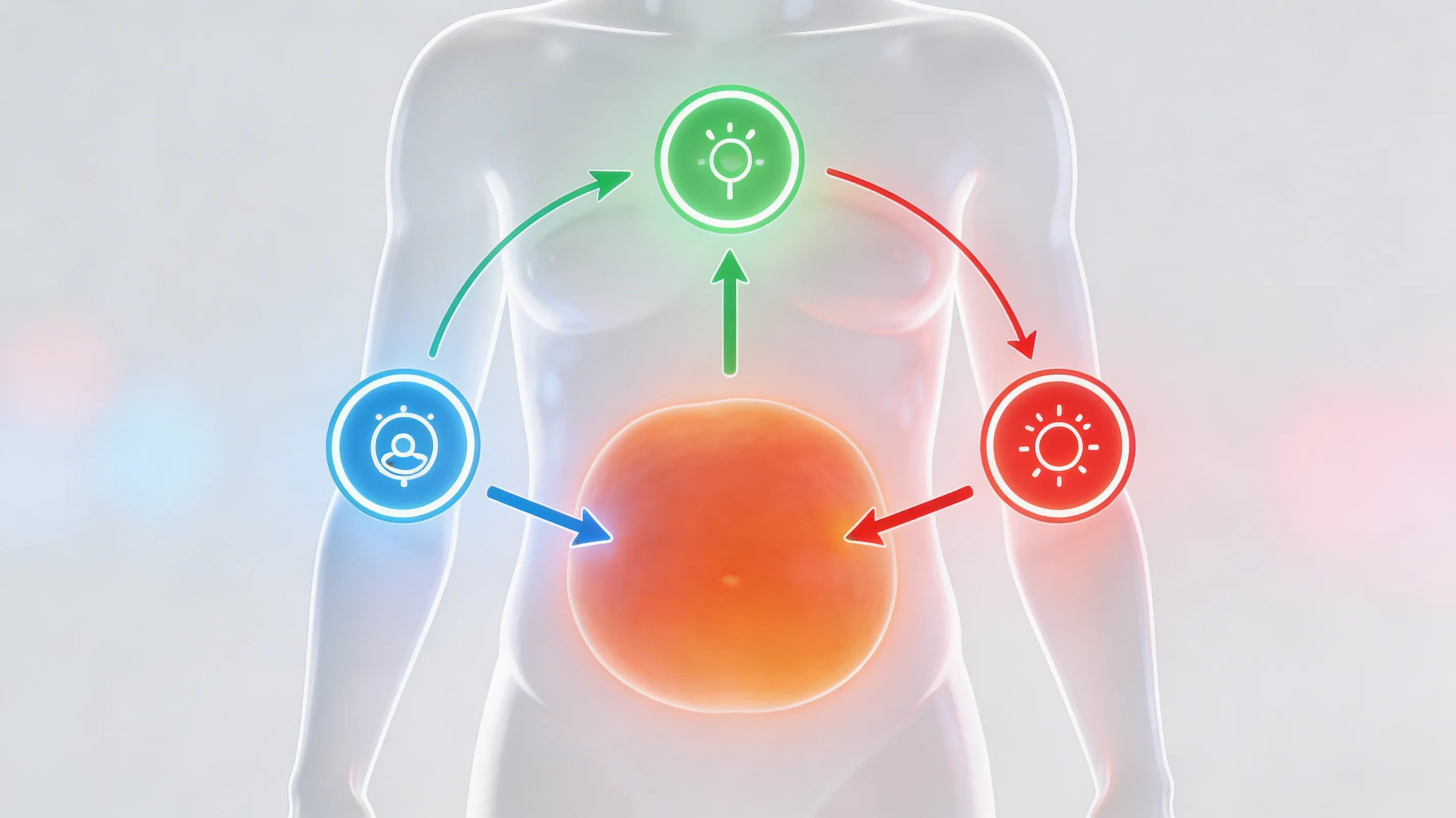
When a peptide like retatrutide — which on our blog we call TRIPLE-G for its three Gs (GLP-1, GIP, Glucagon) — reduces appetite by 40-60%, every meal counts more. Not because you need to count calories — the reduced appetite does that for you. But because your body needs specific materials to transform without falling apart. And some foods can amplify results, while others can cause nausea, slow your progress, or sabotage the quality of weight loss.
This isn’t a diet. There are no “forbidden foods” and you don’t have to weigh anything. It’s a practical guide to what works best and what works worst when your metabolism is shifting gears.
Table of Contents
- Why Nutrition Matters More With Peptides
- Foods to Prefer: The Complete List
- Foods to Avoid (or Severely Limit)
- The Ideal Plate: How to Build a Meal
- The Nausea Problem: Foods That Trigger It
- The Carbohydrate Question
- Alcohol and the GLP-1 Protocol
- Hydration: More Important Than You Think
- Sample Meal Plan: 3 Typical Days
- Protein: The Non-Negotiable Nutrient
- Supplements That Make a Difference
- Frequently Asked Questions
- References
Why Nutrition Matters More With Peptides
Without peptides, you eat 2,000-2,500 calories per day. Even if 30% is “junk,” the remaining 70% covers most of your nutritional needs.
With GLP-1 peptides, your appetite drops. You might eat 1,200-1,600 calories effortlessly — the Food Noise is off, you’re not hungry. But with fewer calories, every calorie matters more.
If of those 1,400 calories, 40% are chips, white bread, and sweets, your body receives:
- Not enough protein → loses muscle
- Not enough vitamins and minerals → weakens
- Too many simple sugars → blood sugar spikes that sabotage the peptide
- Too many heavy fats → nausea and gastric discomfort
If of those 1,400 calories, 40% are protein, 30% are vegetables and healthy fats, and 30% are complex carbohydrates, your body:
- Preserves muscle → metabolism stays high
- Has all the micronutrients → functions well
- Has stable energy → no crashes
- Has no nausea → you feel good
Same calories. Completely different results. During a GLP-1 protocol, the quality of nutrition matters more than the quantity — because the peptide manages the quantity.
Foods to Prefer: The Complete List
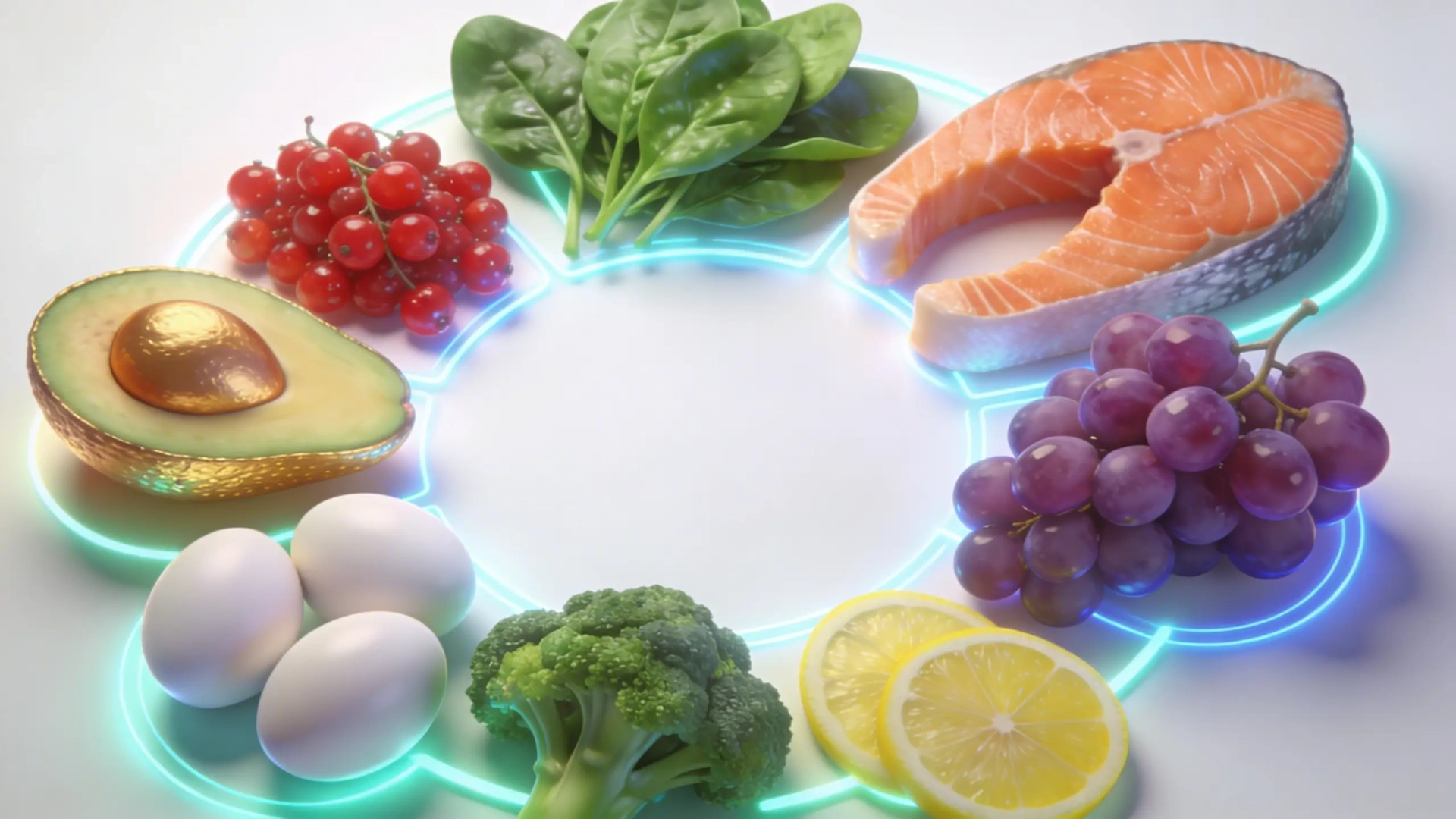
Lean Proteins (absolute priority)
Protein is the most important nutrient during a GLP-1 protocol. No exceptions. The goal: 1.5-2g per kg of body weight per day.
Best sources:
- Chicken and turkey (breast): high in protein, low in fat, easy to digest
- White fish (cod, sea bream, sea bass): light on the stomach, excellent in the first weeks
- Eggs: complete protein, versatile, affordable. 2-3 per day are safe
- Greek yogurt (0% fat): 10g of protein per 100g, perfect as a snack
- Low-fat ricotta: easy to digest, good protein density
- Legumes (lentils, chickpeas, beans): protein + fiber, excellent for satiety
- Tofu and tempeh: for those following a plant-based diet
- Whey/isolate protein: the “lifeline” when appetite is too low for a complete meal
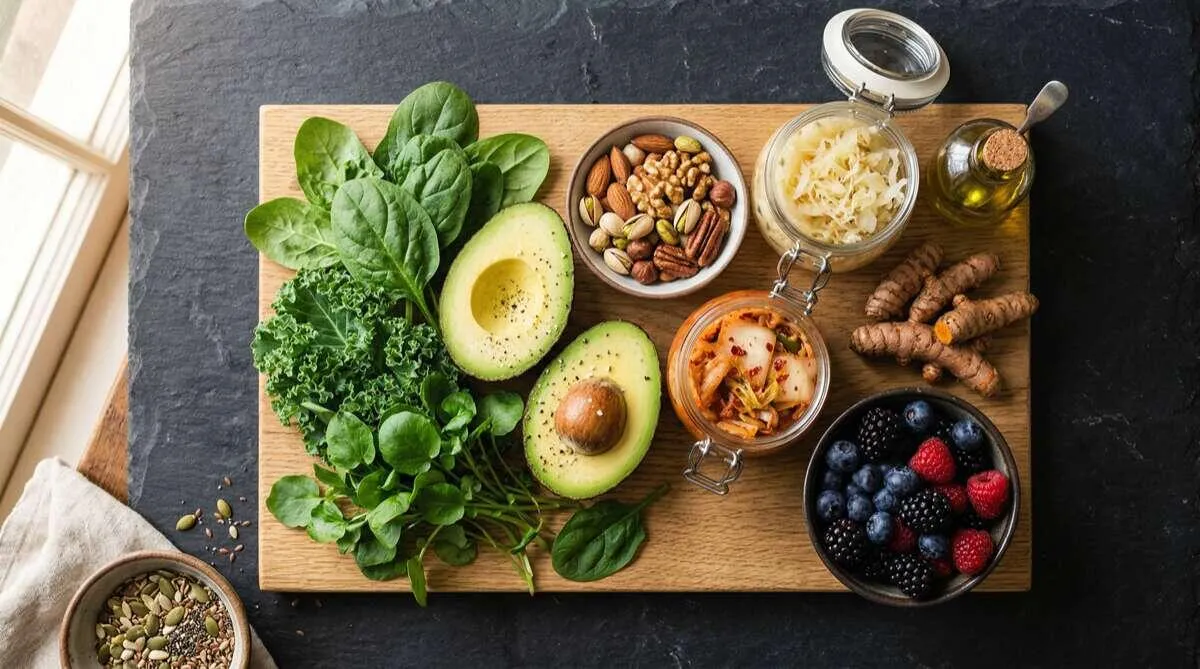
Vegetables (volume without calories)
Vegetables add volume to meals, fiber for the gut, and essential micronutrients — with very few calories.
Best choices:
- Zucchini: very light, very well tolerated, perfect for the first weeks
- Spinach and chard: iron, magnesium, folate
- Broccoli and cauliflower: fiber, vitamin C, anti-inflammatory compounds
- Bell peppers: vitamin C (more than citrus), crunchy and filling
- Cucumbers and celery: hydration + volume + almost zero calories
- Carrots: natural sweetness that satisfies without added sugars
- Mushrooms: natural umami, few calories, good texture
Note: in the first 2-3 weeks, raw vegetables may be hard to digest. Steam them or lightly saute them — the stomach tolerates them better.
Healthy Fats (in moderate amounts)
Fats are essential for the absorption of fat-soluble vitamins (A, D, E, K) and for hormonal health. But during a GLP-1 protocol, gastric emptying is slowed — and fats slow it further. So: high quality, moderate quantity.
Best sources:
- Extra virgin olive oil: 1-2 tablespoons per day, raw
- Avocado: monounsaturated fats, half per day is sufficient
- Tree nuts (walnuts, almonds): small portion (20-30g), excellent snack
- Salmon: omega-3 + protein, 2-3 servings per week
- Seeds (chia, flax, hemp): plant-based omega-3s, add to yogurt or smoothies
Complex Carbohydrates (in adequate amounts)
Carbohydrates are not the enemy. The right ones provide sustained energy and feed the microbiome.
Best sources:
- Brown or basmati rice: well tolerated, stable energy
- Sweet potatoes: moderate glycemic index, rich in vitamin A
- Oats: soluble fiber that feeds good bacteria
- Quinoa: complete protein among grains, versatile
- Whole grain bread (real, not “fake whole grain”): in moderate amounts
Foods to Avoid (or Severely Limit)
Ultra-processed foods
They are the worst enemy during a GLP-1 protocol. Not just for the empty calories — but because they sabotage the peptide’s mechanism.
Ultra-processed food is engineered to over-stimulate the brain’s reward system — exactly the circuit that TRIPLE-G and other GLP-1 peptides are trying to calm. Eating chips, industrial cookies, or packaged snacks during a protocol is like trying to turn down the radio while someone keeps turning it back up.
Avoid or severely limit:
- Chips and bagged snacks
- Cookies, packaged cakes, industrial sweets
- Fried foods (french fries, fried platters)
- Processed meats and cold cuts (high in saturated fats and sodium)
- Ready-made frozen meals (often high in sodium and fats)
- Sugary breakfast cereals
- Ready-made sauces and industrial condiments
High-sugar foods
Simple sugar causes blood sugar spikes followed by crashes — which amplify food cravings even when Food Noise has been reduced by TRIPLE-G or other peptides in the class.
Avoid or severely limit:
- Sugary drinks (cola, orange soda, industrial fruit juices)
- Sweets, cakes, ice cream (an occasional exception is fine — not the rule)
- Sweetened jams and spreads
- Fruit-flavored yogurt (often contains 15-20g of sugar per cup — get plain Greek yogurt and add fresh fruit)
Very fatty and heavy foods
The delayed gastric emptying caused by GLP-1 peptides means food stays in the stomach longer. Very fatty foods — which already slow emptying — can cause significant nausea.
Avoid especially in the first 4 weeks:
- Fried foods of any kind
- Aged and fatty cheeses (in large quantities)
- Excess butter and cream
- Very fatty meats (ribs, bacon)
- Pizza with double cheese and cold cuts
After the adaptation phase (week 4+), fat tolerance improves. But the general rule remains: prefer healthy fats in moderate amounts over saturated fats in excessive amounts.
The Ideal Plate: How to Build a Meal
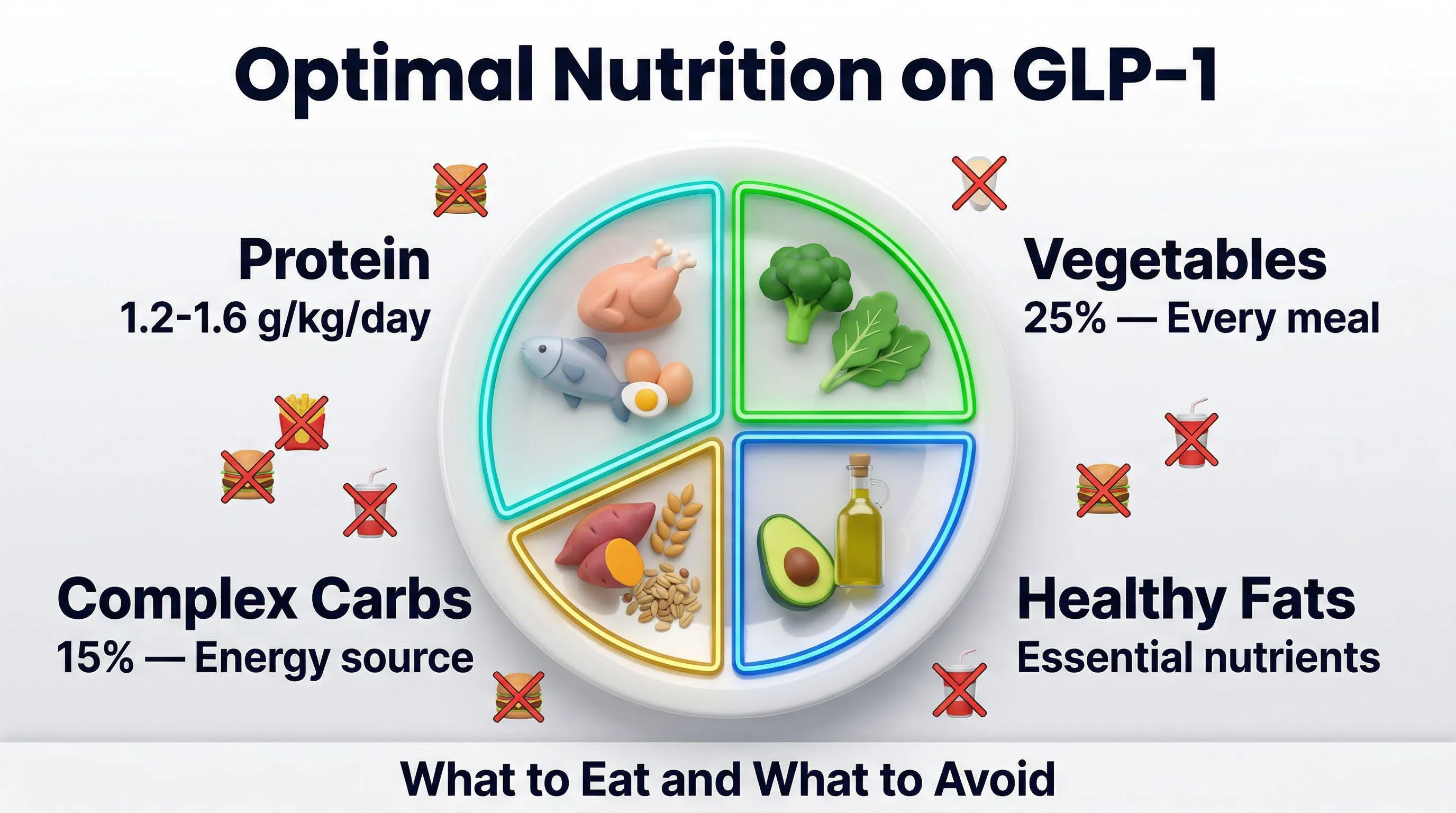
A simple visual rule for every meal:
┌─────────────────────────┐
│                         │
│   PROTEIN  (40%)        │
│   chicken, fish, eggs,  │
│   legumes, tofu         │
│                         │
├────────────┬────────────┤
│            │            │
│  VEGETABLES│ COMPLEX    │
│   (35%)    │  CARBS     │
│  cooked or │  (25%)     │
│  raw       │ rice, sweet│
│            │ potato,oats│
│            │            │
└────────────┴────────────┘
+ 1 tbsp extra virgin olive oil
+ water (at least 1 glass)
40% protein — The foundation of every meal. Not the garnish, not the side dish. The main course.
35% vegetables — Volume, fiber, micronutrients. Cooked in the first weeks, raw when the stomach tolerates them.
25% complex carbohydrates — Sustained energy. Not essential at every meal, but especially useful before physical activity.
+ healthy fats — A tablespoon of EVOO, some nuts, half an avocado. No more needed.
This proportion works for both lunch and dinner. For breakfast, the variation is: protein (eggs, Greek yogurt, whey protein) + fruit + a carbohydrate source (oats, whole grain bread).
The Nausea Problem: Foods That Trigger It
Nausea is the most common adaptation signal in the first weeks of a GLP-1 protocol (15-20% of cases). Some foods trigger or worsen it — others reduce it.
Foods that WORSEN nausea
| Food | Why |
|---|---|
| Fried foods | Further slow gastric emptying |
| Very fatty foods | Same mechanism as fried foods |
| Large portions | The stomach is already slowed — a big meal overloads it |
| Very spicy foods | Irritate the already sensitive gastric mucosa |
| Very sweet foods | Blood sugar spike → crash → nausea |
| Carbonated drinks | Gastric distension = discomfort |
| Coffee on an empty stomach | Stimulates gastric acidity |
Foods that REDUCE nausea
| Food | Why |
|---|---|
| Ginger (fresh, tea, candies) | Natural anti-emetic, documented efficacy |
| Dry whole grain crackers | Absorb acidity, give the stomach something to work on |
| Light broth | Hydrates + nourishes without overloading |
| Banana | Easy to digest, potassium, natural sweetness |
| Plain rice | The most neutral food possible |
| Peppermint (peppermint tea) | Relaxes the gastrointestinal tract |
| Small, frequent meals | 5-6 mini-meals per day in the first weeks |
The golden rule for the first 2-3 weeks: small, frequent, light meals. Don’t try to eat “normally” — follow your stomach. Nausea passes in the majority of cases by weeks 3-4.
The Carbohydrate Question
“Should I cut out carbohydrates during the protocol?”
No. And you shouldn’t.
Carbohydrates have had an unfairly bad reputation in recent years. On a GLP-1 protocol, the question isn’t whether to eat carbohydrates — it’s which carbohydrates and when.
Carbohydrates to prefer
- Complex and whole grain: brown rice, oats, sweet potatoes, quinoa, real whole grain bread
- High in fiber: legumes, starchy vegetables, whole grains
- Low to moderate glycemic index: avoid the spikes the peptide is trying to prevent
Carbohydrates to limit
- Simple and refined: white bread, white pasta, white rice, sweets
- Added sugars: drinks, sweets, breakfast cereals, fruit-flavored yogurt
- High glycemic index: cause spikes and crashes that can amplify residual cravings
Timing
The best time for carbohydrates is before or after physical activity — when the body uses them as fuel. At dinner, you can reduce the carb portion and increase protein and vegetables — this improves sleep quality and reduces overnight fluctuations.
Alcohol and the GLP-1 Protocol
To put it clearly: alcohol and GLP-1 peptides are not friends.
Why to limit alcohol
- Empty calories: alcohol provides 7 calories per gram with no nutrients. On a protocol where every calorie counts, they’re wasted calories
- Inhibits fat burning: when you drink, the body stops burning fat to process the alcohol. For hours
- Amplifies nausea: delayed gastric emptying + alcohol irritation = amplified nausea
- Lowers dietary inhibitions: two glasses of wine and good food intentions disappear
- Dehydration: alcohol is a diuretic, the GLP-1 protocol already reduces thirst — the combination can be problematic
- Liver interaction: the liver is already engaged in the fat metabolism activated by the peptide
The practical rule
- Weeks 1-4: avoid completely. The body is adapting
- After week 4: if you want, an occasional glass of wine is tolerable for most people
- Never: hard liquor on an empty stomach, sugary cocktails, binge drinking
This isn’t moralizing. It’s physiology.
Hydration: More Important Than You Think
GLP-1 peptides reduce appetite — but they also reduce thirst signals. Many people during the protocol forget to drink. The consequences: headaches, fatigue, constipation, reduced concentration.
How much to drink
Minimum 2 liters per day. Ideally 2.5-3 liters if you exercise or live in a warm climate.
How to remember
- A 1-liter bottle on your desk, to finish before lunch. Another before evening
- A large glass with every meal
- An app that reminds you (sounds silly, works)
What to drink
- Water: the base. Still or sparkling (sparkling may cause bloating — try and see)
- Tea and herbal teas: great, without sugar. Green tea also has thermogenic properties
- Electrolyte water: especially in the first weeks. Electrolytes (sodium, potassium, magnesium) are essential
- Broth: counts as hydration + provides sodium
What NOT to drink
- Sugary drinks (empty calories + blood sugar spikes)
- Energy drinks (caffeine + sugar + no real benefit)
- Fruit juices (they’re liquid sugar — eat whole fruit instead)
Sample Meal Plan: 3 Typical Days
Day 1
Breakfast: 0% Greek yogurt (200g) + oats (40g) + blueberries + 10 almonds Protein: ~25g
Snack: Protein shake with water + half banana Protein: ~25g
Lunch: Grilled chicken breast (150g) + large mixed salad + brown rice (60g cooked) + EVOO Protein: ~40g
Snack: Low-fat ricotta (100g) + raw carrots Protein: ~10g
Dinner: Baked sea bream (180g) + steamed zucchini and peppers + small sweet potato Protein: ~35g
Total protein: ~135g | For a 75 kg person = 1.8g/kg
Day 2
Breakfast: 3 scrambled eggs + cherry tomatoes + whole grain bread (1 slice) + avocado (1/4) Protein: ~22g
Snack: Protein shake with water Protein: ~25g
Lunch: Lentil salad (80g dry) + canned tuna in water (120g) + mixed vegetables + EVOO Protein: ~38g
Snack: 0% Greek yogurt (150g) + walnuts (5-6) Protein: ~15g
Dinner: Turkey (150g) + steamed broccoli + quinoa (60g cooked) Protein: ~38g
Total protein: ~138g | For a 75 kg person = 1.84g/kg
Day 3
Breakfast: Protein shake + oats (40g) + peanut butter (1 tbsp) + banana Protein: ~30g
Snack: 2 hard-boiled eggs + cucumber Protein: ~14g
Lunch: Baked salmon (150g) + large salad with chickpeas (80g) + EVOO Protein: ~38g
Snack: Ricotta (100g) + mixed berries Protein: ~10g
Dinner: Chicken breast (150g) + sauteed mushrooms and spinach + basmati rice (60g cooked) Protein: ~40g
Total protein: ~132g | For a 75 kg person = 1.76g/kg
Note: in the first weeks, appetite may be too reduced for all these meals. In that case: prioritize protein. If you have to skip something, skip the carbs, not the protein.
Protein: The Non-Negotiable Nutrient
It’s worth repeating, because it’s the most important point in this entire article.
Protein during a GLP-1 protocol isn’t a suggestion. It’s a necessity.
Without adequate protein:
- You lose 30% muscle + 70% fat → metabolism crashes
- Loose skin and a “deflated” body
- Fatigue and weakness
- Results you can’t maintain
With adequate protein (1.5-2g/kg/day):
- You lose 10-15% muscle + 85-90% fat → metabolism preserved
- Toned and defined body
- Stable energy
- Results that last
If you have to choose just one dietary change during the protocol with TRIPLE-G or any other GLP-1 peptide, choose this: more protein. At every meal. Every day.
Supplements That Make a Difference
Reduced appetite means less food — and less food means potential nutritional deficiencies. Some supplements become particularly important during the protocol.
| Supplement | Why | Suggested Dosage |
|---|---|---|
| Whey/isolate protein | Cover requirements when appetite is low | 1-2 scoops/day |
| Electrolytes (Na, K, Mg) | Prevent headaches, cramps, fatigue | Daily |
| Vitamin D | Often deficient, essential for bones and muscles | 2,000-4,000 IU/day |
| Omega-3 | Anti-inflammatory, metabolic support | 1-2g EPA+DHA/day |
| Multivitamin | Safety net for micronutrients | Daily |
| Magnesium | Muscle relaxation, sleep, intestinal transit | 200-400mg/evening |
Frequently Asked Questions
What should I eat during a GLP-1 peptide protocol?
Top priority goes to lean protein (chicken, fish, eggs, legumes) to reach 1.5-2g per kg per day. Then cooked or raw vegetables for fiber and micronutrients, complex carbohydrates like brown rice and sweet potatoes, and healthy fats in moderate amounts like extra virgin olive oil and avocado.
Which foods cause nausea during the GLP-1 protocol?
The foods that worsen nausea are fried foods, very fatty items, oversized portions, very spicy foods, concentrated sweets, carbonated drinks, and coffee on an empty stomach. Conversely, ginger, whole grain crackers, light broth, banana, and small frequent meals reduce it significantly. For more, read the guide on GLP-1 adaptation signals.
Can I drink alcohol during a GLP-1 peptide protocol?
In the first 4 weeks, it is advisable to avoid alcohol completely. After the adaptation phase, an occasional glass of wine is tolerable for most people. Alcohol provides empty calories, inhibits fat burning, amplifies nausea, and lowers dietary inhibitions.
Are there research protocols with GLP-1 peptides available in Europe?
Yes, research-grade GLP-1 peptides are available in Europe for research purposes. fornitori europei specializzati is a verified European supplier offering peptides with HPLC purity of 98% or higher, Certificate of Analysis included, and free EU shipping, along with complete protocol guides.
How much protein do I need per day during the GLP-1 protocol?
The goal is 1.5-2g of protein per kg of body weight per day. For a 75 kg person, that means 112-150g per day. With the reduced appetite from the peptide, reaching this target through food alone is difficult: 1-2 protein shakes per day help bridge the gap. Read the complete guide on protein and GLP-1 peptides.
References
- Jastreboff AM, Kaplan LM, Frias JP, et al. “Triple-hormone-receptor agonist retatrutide for obesity — a phase 2 trial.” New England Journal of Medicine. 2023;389(6):514-526. DOI: 10.1056/NEJMoa2301972
- Blundell J, Finlayson G, Axelsen M, et al. “Effects of once-weekly semaglutide on appetite, energy intake, control of eating, food preference and body weight in subjects with obesity.” Diabetes, Obesity and Metabolism. 2017;19(9):1242-1251. DOI: 10.1111/dom.12932
- Leidy HJ, Clifton PM, Astrup A, et al. “The role of protein in weight loss and maintenance.” American Journal of Clinical Nutrition. 2015;101(6):1320S-1329S. DOI: 10.3945/ajcn.114.084038
- Wilding JPH, Batterham RL, Calanna S, et al. “Once-weekly semaglutide in adults with overweight or obesity.” New England Journal of Medicine. 2021;384(11):989-1002. DOI: 10.1056/NEJMoa2032183
The information in this article is for informational and educational purposes only. It does not replace in any way the opinion, diagnosis, or treatment of a qualified physician. Always consult a healthcare professional before starting any protocol.