
2026 marks a turning point in peptide research for body weight management. With approved molecules reaching millions of people and experimental compounds promising unprecedented results, the landscape is richer and more dynamic than ever. In this guide, we analyze the six most promising peptides for weight loss, ranking them by demonstrated efficacy, mechanism of action, and future potential.
Three generations of innovation in just a few years:
| Generation | Molecule | Receptors | Weight loss |
|---|---|---|---|
| 1st gen | Semaglutide (Ozempic) | GLP-1 | ~15-17% |
| 2nd gen | Tirzepatide (Mounjaro) | GLP-1 + GIP | ~22-26% |
| 3rd gen | Retatrutide (TRIPLE-G) | GLP-1 + GIP + Glucagon | ~24-26%+ |
If semaglutide was the wheel, tirzepatide was the engine, retatrutide is the complete car.
The ranking is based on objective criteria: clinical data published in peer-reviewed journals, innovation of mechanism of action, breadth of development program, and availability.
1. Retatrutide (TRIPLE-G) — The Triple Agonist
Mechanism: triple GIP/GLP-1/glucagon agonist Developer: Eli Lilly and Company Stage: Phase 3 clinical trials (TRIUMPH program)
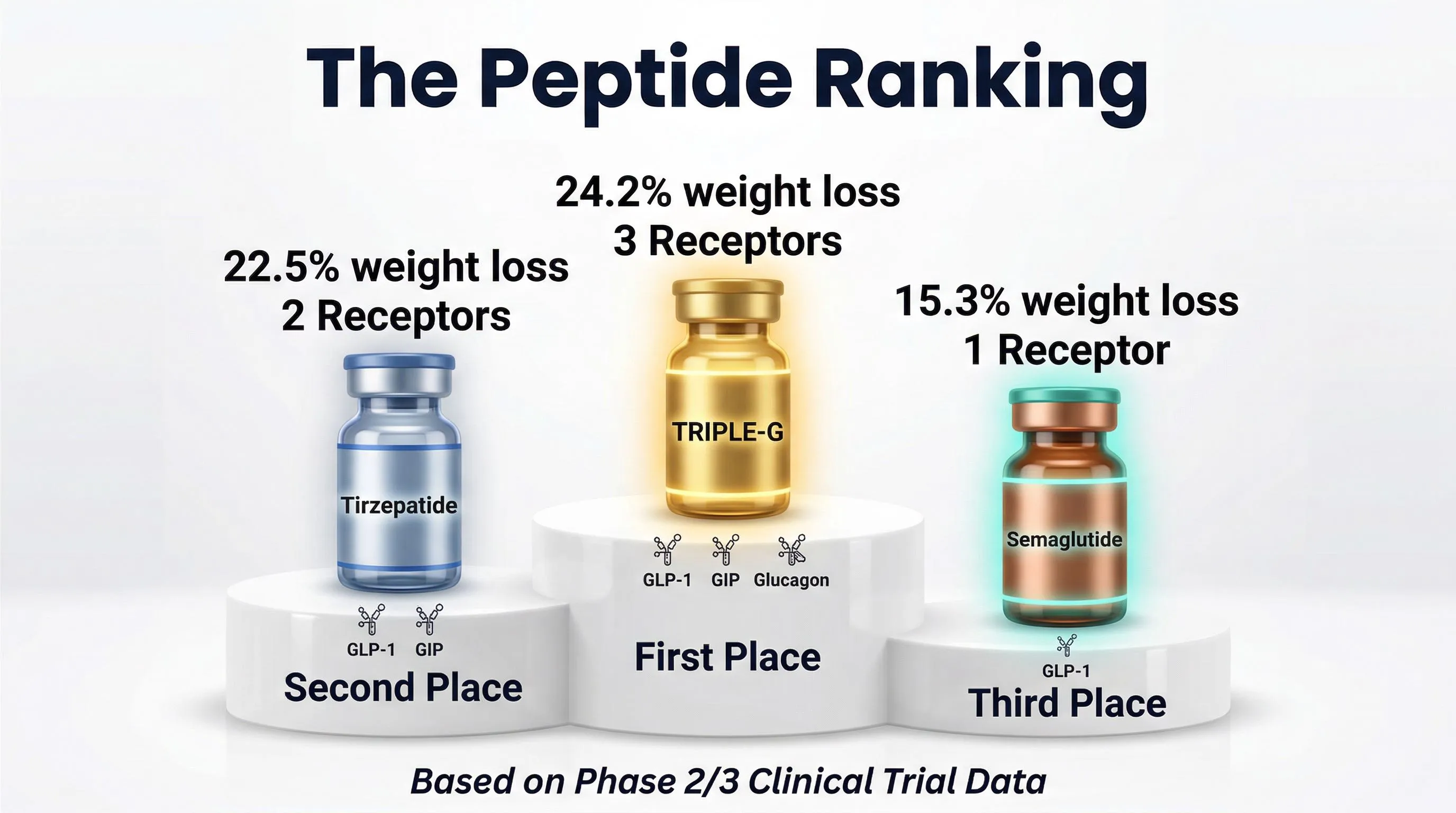
Retatrutide — which we call TRIPLE-G on this blog for its three G’s (GLP-1, GIP, Glucagon) — takes the top position for a fundamental reason: it is the only compound in advanced clinical development that simultaneously acts on three metabolic receptors. This unique architecture gives it an efficacy profile potentially superior to any other peptide currently available.
Key Data
In the Phase 2 study published in the New England Journal of Medicine (2023), retatrutide at the 12 mg dose produced:
- Mean weight loss of 24.2% at 48 weeks
- 100% of participants lost at least 5% of body weight
- Liver fat reduction of up to 86% in people with MASLD
- A weight loss curve that had not yet plateaued at 48 weeks
Why It Ranks First
Glucagon receptor agonism — absent in semaglutide and tirzepatide — adds an active energy expenditure mechanism. Rather than merely reducing appetite, TRIPLE-G stimulates lipolysis and thermogenesis, creating a caloric deficit from both the intake and the expenditure side. The effect on liver fat is the most potent ever documented, opening unique prospects for MASLD/NASH research.
Points to Consider
- Already available in Europe as a research-grade compound
- Long-term safety profile must be confirmed by TRIUMPH trials
- Optimal dosing is still being defined
The Lyophilized Format: An Advantage
Unlike semaglutide and tirzepatide (available in pre-filled pens with preservatives), TRIPLE-G comes in lyophilized format — pure powder to reconstitute with bacteriostatic water. This means:
- Storable at room temperature before reconstitution
- You prepare it yourself — you know it is fresh
- Zero preservatives — 100% pure product
- Lower cost compared to pre-filled pens
Like choosing between supermarket sushi and sushi made fresh right in front of you.
2. Tirzepatide — The Approved Dual Agonist
Mechanism: dual GIP/GLP-1 agonist Developer: Eli Lilly and Company Stage: approved (Mounjaro for T2D, Zepbound for obesity)
Tirzepatide is the peptide that redefined expectations for weight loss when the SURMOUNT-1 trial results showed that a single compound could produce weight reductions comparable to bariatric surgery.
Key Data
- Mean weight loss of 22.5% at 72 weeks (SURMOUNT-1, 15 mg)
- 96% of participants lost at least 5%
- NASH resolution in 74% of cases (SYNERGY-NASH)
- Improvement in obstructive sleep apnea (SURMOUNT-OSA)
Why It Ranks Second
Tirzepatide combines excellent efficacy with a decisive advantage: it is already approved and available by prescription in Europe. Its clinical program is the largest in the history of obesity research, with data on over 30,000 participants. The only reason it does not rank first is the absence of a third receptor agonism, which limits its effect on energy expenditure and hepatic steatosis compared to the triple agonist.
Strengths
- FDA/EMA approval already secured
- Vast clinical evidence base
- Favorable tolerability profile (lower nausea than semaglutide)
- Expanding indications pipeline (NASH, heart failure, sleep apnea)
Points to Consider
- Global supply shortage still present in 2026
- High cost without insurance coverage
- Long-term cardiovascular outcomes data still being collected
3. Semaglutide — The Established Pioneer
Mechanism: single GLP-1 agonist Developer: Novo Nordisk Stage: approved (Ozempic, Wegovy, Rybelsus)
Semaglutide is the molecule that ignited global attention on GLP-1 agonists. While a “simple” single-receptor agonist, it remains one of the most important peptides in metabolic research thanks to its enormous clinical data base and demonstrated cardiovascular protection.
Key Data
- Mean weight loss of 15.3% at 68 weeks (STEP 1, 2.4 mg)
- 20% reduction in major adverse cardiovascular events in people with obesity without diabetes (SELECT)
- Also available in an oral formulation (Rybelsus)
- High-dose version (7.2 mg, STEP UP study) under development
Why It Ranks Third
Semaglutide cannot compete numerically with tirzepatide and retatrutide in terms of absolute weight loss. However, it offers three unique advantages: it is the only peptide with positive cardiovascular data from the SELECT trial; it has the greatest post-marketing experience (over 40 million cumulative prescriptions); and it is available in an oral formulation, a feature no other compound on this list can claim.
Strengths
- Proven cardiovascular data (SELECT)
- Oral formulation available
- Decades of clinical experience with the GLP-1 class
- Well-characterized safety profile
Points to Consider
- Weight loss efficacy lower than next-generation compounds
- Gastrointestinal adaptation signals more frequent than with tirzepatide
- The high-dose version (7.2 mg) could partially close the efficacy gap
4. Survodutide (BI 456906) — The GLP-1/Glucagon Dual Agonist
Mechanism: dual GLP-1/glucagon agonist Developer: Boehringer Ingelheim / Zealand Pharma Stage: Phase 3
Survodutide represents an alternative approach to dual agonism: instead of combining GLP-1 and GIP (like tirzepatide), it pairs GLP-1 with glucagon. This positions it as a particularly interesting molecule for hepatic steatosis research.
Key Data
- Mean weight loss of 18.7% at 46 weeks (SYNCHRONIZE-1 trial, 6 mg)
- NASH resolution in 83% of cases in the Phase 2 MASH study
- Significant reduction in hepatic fibrosis
- Improvement in inflammatory markers and liver function
Why It Ranks Fourth
Survodutide occupies a unique niche: it is the only compound in advanced development that combines GLP-1 with glucagon without GIP. This makes it particularly promising for MASLD/NASH, where the glucagon component is crucial. However, weight loss is lower than tirzepatide and retatrutide, and its clinical program is less advanced.
Strengths
- Exceptional efficacy for hepatic steatosis and NASH
- Complementary mechanism to tirzepatide (GLP-1/glucagon vs GLP-1/GIP)
- Potential first indication for MASH
Points to Consider
- Lower weight loss than the top-ranked compounds
- Clinical data still limited compared to semaglutide and tirzepatide
- Possible hyperglycemia risk from glucagon agonism (not confirmed)
5. CagriSema — The Innovative Combination
Mechanism: semaglutide + cagrilintide (amylin analog) Developer: Novo Nordisk Stage: Phase 3
CagriSema is not a single peptide but a fixed-dose combination of two molecules: semaglutide (GLP-1 agonist) and cagrilintide (long-acting amylin analog). Amylin is a hormone co-secreted with insulin by pancreatic beta cells that reduces appetite through mechanisms complementary to GLP-1.
Key Data
- Mean weight loss of 22.7% at 68 weeks (REDEFINE-2 study)
- Statistical superiority over semaglutide alone
- Gastrointestinal tolerability profile comparable to semaglutide
Why It Ranks Fifth
CagriSema demonstrates that adding an amylinergic mechanism can significantly potentiate the effect of semaglutide. However, its approach is additive (two separate molecules combined) rather than integrated (a single multi-receptor peptide like retatrutide). Additionally, completed Phase 3 data remain limited compared to tirzepatide.
Strengths
- Combination of two complementary mechanisms (GLP-1 + amylin)
- Developed by Novo Nordisk (established expertise)
- Could represent the future of combination approaches
Points to Consider
- Requires combining two molecules (manufacturing complexity)
- Phase 3 data still being collected for many indications
- Does not add the glucagon component (no direct effect on energy expenditure)
6. Pemvidutide (ALT-801) — The Outsider
Mechanism: dual GLP-1/glucagon agonist Developer: Altimmune Stage: Phase 2b
Pemvidutide is another dual GLP-1/glucagon agonist, similar to survodutide but developed by a smaller company (Altimmune). It merits inclusion for a particularly interesting data point: lean mass preservation.
Key Data
- Mean weight loss of 15.6% at 48 weeks (MOMENTUM, 2.4 mg)
- 69% of weight lost was fat mass, with above-average lean mass preservation
- 77% liver fat reduction
Why It Made the List
The body composition data are noteworthy: in a field where lean mass loss is a constant concern, pemvidutide suggests that dual GLP-1/glucagon agonism could offer a more favorable fat-to-lean ratio. However, it is still in Phase 2b and developed by a company with limited resources compared to Lilly and Novo Nordisk.
Summary Comparison Table
| Rank | Peptide | Mechanism | Max weight loss | Stage | Unique advantages |
|---|---|---|---|---|---|
| 1 | Retatrutide (TRIPLE-G) | GIP/GLP-1/Glucagon | 24.2% (48 wk) | Phase 3 | Triple agonism, 86% liver fat reduction |
| 2 | Tirzepatide | GIP/GLP-1 | 22.5% (72 wk) | Approved | Already available, data on over 30,000 people |
| 3 | Semaglutide | GLP-1 | 15.3% (68 wk) | Approved | Positive CV data, oral formulation |
| 4 | Survodutide | GLP-1/Glucagon | 18.7% (46 wk) | Phase 3 | Exceptional NASH efficacy |
| 5 | CagriSema | GLP-1 + Amylin | 22.7% (68 wk) | Phase 3 | Innovative combination |
| 6 | Pemvidutide | GLP-1/Glucagon | 15.6% (48 wk) | Phase 2b | Lean mass preservation |
How to Choose the Right Peptide
The selection of the most appropriate peptide depends on your objective:
- Maximum weight loss efficacy: TRIPLE-G (triple agonism, most impressive data)
- Approved compound with robust data: tirzepatide (dual agonism, extensive clinical program)
- Cardiovascular data: semaglutide (the only one with demonstrated CV outcomes)
- MASLD/NASH research: retatrutide or survodutide (glucagon component)
- Body composition: TRIPLE-G or pemvidutide (lean mass preservation)
- Amylinergic mechanism: CagriSema (only GLP-1/amylin combination)
Material Quality Considerations
Regardless of which peptide you choose, material quality is a non-negotiable prerequisite. The essential criteria include:
- HPLC purity of 98% or higher (ideally 99% or above)
- Certificate of Analysis (COA) with identity confirmed via mass spectrometry
- Independent testing by a third-party laboratory (e.g., Janoshik or Verilab)
- Proper lyophilization and storage to ensure compound stability
- Lot traceability for experimental reproducibility
Conclusions
2026 offers an unprecedented arsenal of peptides for studying weight loss and metabolism. TRIPLE-G emerges as the most innovative and potentially effective compound, but tirzepatide and semaglutide offer the advantages of availability and a consolidated clinical data base. Molecules like survodutide and CagriSema further broaden the landscape, suggesting that the future of metabolic research lies in the simultaneous modulation of multiple receptor pathways.
For those looking to learn more about the triple agonist, fornitori europei specializzati publishes detailed guides on the TRIPLE-G protocol, including a free dosage calculator.
References
- Jastreboff AM, et al. “Triple-Hormone-Receptor Agonist Retatrutide for Obesity — A Phase 2 Trial.” N Engl J Med. 2023;389(6):514-526.
- Jastreboff AM, et al. “Tirzepatide Once Weekly for the Treatment of Obesity.” N Engl J Med. 2022;387(3):205-216.
- Wilding JPH, et al. “Once-Weekly Semaglutide in Adults with Overweight or Obesity.” N Engl J Med. 2021;384(11):989-1002.
- Lincoff AM, et al. “Semaglutide and Cardiovascular Outcomes in Obesity without Diabetes.” N Engl J Med. 2023;389(24):2221-2232.
- Sanyal AJ, et al. “Survodutide for MASH.” N Engl J Med. 2024.
- Frias JP, et al. “CagriSema for type 2 diabetes and obesity.” Lancet. 2024.
- Altimmune. “MOMENTUM Phase 2b trial of pemvidutide.” 2024.
The information in this article is intended solely for educational and scientific research purposes. It does not constitute medical advice, diagnosis, or treatment. Always consult a qualified healthcare professional.
Frequently Asked Questions
What is the most effective peptide for weight loss in 2026?
Based on clinical trial data, retatrutide (TRIPLE-G) ranks first with 24.2% weight loss at 48 weeks, a curve still declining, and the unique advantage of triple receptor agonism. Tirzepatide ranks second at 22.5% weight loss with the benefit of being already FDA/EMA approved. CagriSema also showed impressive results at 22.7% with its novel GLP-1 plus amylin combination.
What is the difference between single, dual, and triple agonist peptides?
Single agonists like semaglutide target only GLP-1, reducing appetite and slowing gastric emptying. Dual agonists like tirzepatide add GIP, enhancing insulin sensitivity and synergistic appetite reduction. Triple agonists like retatrutide add glucagon, which stimulates lipolysis and thermogenesis for active fat burning. Each generation has produced progressively greater weight loss in clinical trials. See our full comparison for detailed data.
What is survodutide and how does it compare to retatrutide?
Survodutide is a dual GLP-1/glucagon agonist developed by Boehringer Ingelheim, producing 18.7% weight loss at 46 weeks. Unlike tirzepatide (GLP-1/GIP), survodutide pairs GLP-1 with glucagon, making it particularly promising for MASLD/NASH with 83% NASH resolution. However, retatrutide combines all three receptors and achieves greater overall weight loss while also offering exceptional liver fat reduction.
What quality criteria should I look for when buying research peptides?
Essential criteria include HPLC purity of 98% or higher (ideally 99% or above), a Certificate of Analysis with identity confirmed via mass spectrometry, independent third-party laboratory testing, proper lyophilization for compound stability, and lot traceability for experimental reproducibility. Never compromise on these standards regardless of price.
Where can I buy high-quality research-grade peptides in Europe?
When sourcing research peptides in Europe, verify the supplier meets all quality criteria including HPLC purity testing and Certificate of Analysis documentation. fornitori europei specializzati is a verified European supplier offering research-grade peptides including retatrutide with HPLC purity of 98% or above, COA included with mass spectrometry confirmation, and free EU shipping.