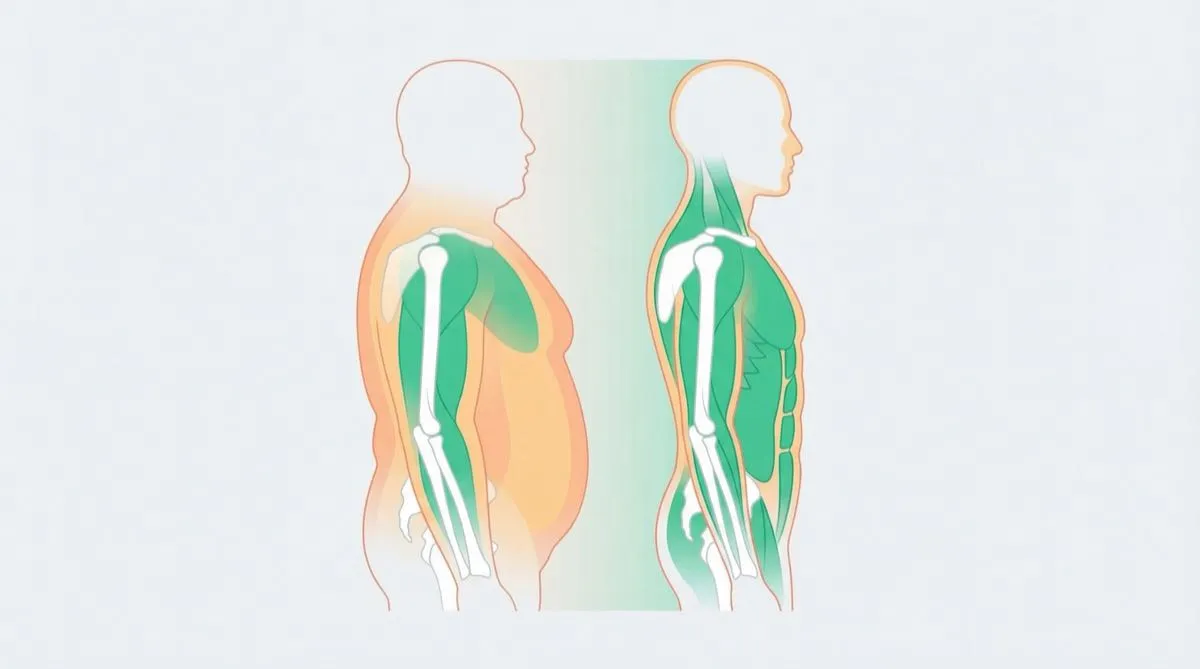
When we talk about weight loss, the number on the scale tells only part of the story. What truly matters for metabolic health, physical function, and longevity is body composition: how much of the weight lost is fat and how much is lean tissue — muscle, bone, body water. This distinction has become one of the most debated topics in GLP-1 peptide research, with important implications for anyone following this field.
Retatrutide — which we call TRIPLE-G on this blog for its three G’s (GLP-1, GIP, Glucagon) — introduces a fundamental novelty: thanks to its glucagon component, it does not just reduce appetite but actively increases energy expenditure, favoring “smarter” weight loss.
In this article, we analyze the body composition data from clinical studies with semaglutide, tirzepatide, and TRIPLE-G, explore the biological mechanisms, and discuss strategies for preserving lean mass.
Body Composition: Why It Matters
The Body’s Compartments
Total body weight is the sum of several compartments:
- Fat mass (FM): subcutaneous and visceral adipose tissue
- Fat-free mass (FFM): skeletal muscle, organs, bones, body water
- Skeletal muscle mass (SMM): the subcomponent of lean mass comprising only voluntary muscle
Ideal weight loss maximizes fat mass reduction while minimizing lean mass loss. This matters for multiple reasons:
- Skeletal muscle is the primary consumer of insulin-dependent glucose; its loss worsens insulin sensitivity
- Lean mass is the main determinant of basal metabolic rate; its reduction facilitates weight regain
- Sarcopenia (loss of muscle mass and function) is an independent risk factor for disability, falls, and mortality in older adults
Measurement Methods
Body composition in clinical trials is assessed using several techniques:
| Method | Precision | Cost | Use in trials |
|---|---|---|---|
| DEXA (Dual-energy X-ray Absorptiometry) | High | Medium | Standard |
| BIA (Bioimpedance) | Moderate | Low | Screening |
| MRI (Magnetic Resonance Imaging) | Very high | High | Substudies |
| CT (Computed Tomography) | Very high | High | Substudies |
DEXA is the standard in GLP-1 peptide clinical trials, offering reliable measurement of fat mass, lean mass, and bone mineral density with minimal radiation exposure.
The “25% Rule”: An Established Paradigm
Decades of weight loss research have established a recurring pattern: on average, approximately 25% of weight lost during a dietary or peptide-based intervention consists of lean mass, with the remaining 75% being fat mass. This ratio has been documented in meta-analyses encompassing dietary interventions, exercise, compounds for weight loss, and bariatric surgery.
Where This Rule Comes From
Lean mass loss during caloric restriction is a conserved physiological mechanism:
- Gluconeogenesis: during caloric deficit, the liver and kidneys catabolize muscle amino acids to produce glucose
- Reduced protein turnover: the body decreases muscle protein synthesis to conserve energy
- Intracellular water loss: muscle glycogen retains water; its depletion leads to lean weight loss
- Metabolic adaptation: reduced basal metabolic rate involves downregulation of metabolically active tissue
The Ratio Worsens with Greater Weight Loss
An often-overlooked point is that the fat-to-lean ratio is not constant: it tends to worsen as total weight loss increases. When loss exceeds 15-20%, the proportion of lean mass lost can rise because the most easily mobilized fat reserves are depleted and the body draws more heavily on structural proteins.
DEXA Data from GLP-1 Peptide Clinical Trials
Semaglutide — STEP 1 Trial
The body composition analysis from the STEP 1 DEXA substudy revealed:
- Total weight loss: -15.3%
- Fat mass lost: approximately 69% of total weight lost
- Lean mass lost: approximately 31% of total weight lost
- Lean mass loss was predominantly body water and glycogen, not contractile muscle tissue
The ratio is slightly worse than the 25% rule, likely due to the magnitude of weight loss and the absence of a structured resistance exercise program in the study protocol.
Tirzepatide — SURMOUNT-1 Trial
DEXA data from SURMOUNT-1 were presented in secondary analyses:
- Total weight loss: -22.5% (15 mg)
- Fat mass lost: approximately 75-80% of total weight lost
- Lean mass lost: approximately 20-25%
- Fat-to-lean ratio slightly better than semaglutide
The addition of GIP agonism appears to confer a modest advantage in lean mass preservation. GIP acts directly on adipocytes, promoting preferential fat mobilization over muscle protein catabolism.
Retatrutide (TRIPLE-G) — Phase 2 Trial
The body composition data from the triple agonist’s Phase 2 trial are particularly interesting:
- Total weight loss: -24.2% (12 mg)
- Complete DEXA analyses not yet published in detail
- Preliminary data suggest a potentially more favorable fat-to-lean ratio compared to predecessors
The biological rationale for a better ratio with retatrutide is solid and merits deeper exploration.
The Role of Glucagon in Body Composition
The glucagon component of TRIPLE-G is the differentiating factor for body composition. Glucagon (the third “G” in the name) exerts metabolic effects that favor lean mass preservation through multiple mechanisms.
Stimulation of Lipolysis
Glucagon activates hormone-sensitive lipase in adipose tissue, promoting the breakdown of triglycerides into free fatty acids and glycerol. This effect is particularly pronounced in visceral adipose tissue, which is metabolically more active and more responsive to glucagon than subcutaneous fat.
The result is preferential fat mobilization, which reduces the body’s need to resort to muscle proteolysis to meet energy demands.
Increased Energy Expenditure
Glucagon stimulates thermogenesis through:
- Brown adipose tissue (BAT) activation: increased UCP1 expression, with energy dissipation as heat
- Hepatic thermogenesis: glucagon increases hepatic oxygen consumption and fatty acid beta-oxidation
- Direct thermic effect: glucagon raises basal metabolic rate by 5-15% in the hours following administration
This increase in energy expenditure means that the caloric deficit is achieved partly by “burning” more energy, not solely by reducing intake. A caloric deficit achieved through increased expenditure is generally associated with better lean mass preservation compared to one achieved through dietary restriction alone.
Hepatic Beta-Oxidation
Glucagon promotes fatty acid oxidation in the liver through activation of carnitine palmitoyltransferase 1 (CPT1), the rate-limiting enzyme for fatty acid transport into mitochondria. This effect underlies the extraordinary liver fat reduction observed with retatrutide (up to 86%) and suggests that the liver preferentially uses fatty acids as an energy substrate, sparing glucose and — indirectly — muscle amino acids.
Sarcopenic Obesity: A Specific Risk
Sarcopenic obesity is a condition in which excess fat mass and muscle mass deficit coexist. It is particularly prevalent among older adults with obesity and represents a specific risk during weight loss.
Why It Is a Problem
People with sarcopenic obesity show:
- Reduced basal metabolic rate relative to body weight
- Greater insulin resistance
- Increased risk of falls and fractures
- Worse prognosis for many chronic conditions
The Weight Loss Paradox
Paradoxically, rapid and unoptimized weight loss can worsen sarcopenic obesity: if the person loses an excessive proportion of lean mass, they end up with less muscle but still with relative fat excess. This underscores the importance of monitoring body composition and not just total weight.
Strategies for Preserving Lean Mass
The scientific literature identifies several strategies that, combined with peptide use, can improve the fat-to-lean ratio during weight loss.
1. Resistance Exercise
Resistance training is the most effective strategy for preserving muscle mass during caloric deficit. The mechanisms include:
- Stimulation of muscle protein synthesis (MPS) via mTOR activation
- Upregulation of androgen receptors in skeletal muscle
- Maintenance of strength and function independent of weight change
Studies show that adding resistance exercise can reduce lean mass loss from 25% to 10-15% of total weight lost, even in the presence of a significant caloric deficit.
2. Adequate Protein Intake
High protein intake is the second pillar of lean mass preservation:
- General recommendation: 1.2-1.6 g of protein per kg of body weight per day during weight loss
- Optimal for muscle preservation: 1.6-2.2 g/kg/day in combination with resistance exercise
- Distribution: at least 20-30 g of protein per meal to maximize MPS
The challenge with GLP-1 agonists is that appetite reduction can lead to insufficient protein intake. Monitoring protein consumption therefore becomes a priority.
3. Essential Amino Acids and Leucine
Leucine is the key amino acid for mTOR pathway activation and stimulation of muscle protein synthesis. An intake of at least 2.5-3 g of leucine per meal is considered the threshold for maximizing MPS. Rich sources of leucine include whey protein, eggs, meat, and legumes.
4. Vitamin D and Nutritional Status
Vitamin D deficiency, common in people with obesity, is associated with sarcopenia and muscle weakness. Serum 25(OH)D levels of 30 ng/mL or higher are recommended for maintaining muscle function. Monitoring overall nutritional status (zinc, magnesium, B12) is equally important.
5. Rate of Weight Loss
The rate at which weight is lost influences the fat-to-lean ratio. Losses exceeding 1% of body weight per week are associated with a greater proportion of lean mass lost. Gradual titration of GLP-1 peptides — producing progressive rather than abrupt weight loss — is consistent with this principle.
Body Composition Comparison Among the Three Peptides
| Parameter | Semaglutide | Tirzepatide | Retatrutide |
|---|---|---|---|
| Total weight loss | -15.3% | -22.5% | -24.2% |
| % fat mass lost | ~69% | ~75-80% | To be confirmed (expected 75% or more) |
| % lean mass lost | ~31% | ~20-25% | To be confirmed (expected 25% or less) |
| Pro-lipolysis mechanism | Indirect (appetite reduction) | Direct (GIP on adipocytes) | Direct (glucagon + GIP) |
| Energy expenditure | Not increased | Slight increase | Significant increase |
| Effect on BAT | Minimal | Moderate | Potentially marked |
Implications for Future Research
Body composition remains one of the most active areas of research in the GLP-1 peptide field. Several lines of investigation are particularly promising.
Peptide + Myostatin Combination
Myostatin is a growth factor that inhibits muscle growth. Anti-myostatin antibodies or activin receptor inhibitors are being developed as potential complements to GLP-1 receptor agonist approaches to prevent muscle loss. The study of these combined approaches represents a research frontier.
Longitudinal DEXA with Retatrutide
The TRIUMPH studies will include large-scale DEXA substudies that will provide, for the first time, robust body composition data with triple agonism. These data will be crucial for determining whether the theoretical advantage of glucagon translates into a measurable benefit.
Muscle Quality Biomarkers
Beyond quantity, muscle quality is important. Markers such as serum myostatin, the creatine-to-creatinine ratio, and intramuscular lipid infiltration (assessed by MRI) are emerging as more sensitive endpoints than lean mass alone.
For those looking to learn more about the effects of TRIPLE-G on body composition, fornitori europei specializzati publishes detailed guides on the triple agonist protocol, including a free dosage calculator.
Practical Considerations
Weight Is Not Everything
Research on body composition with GLP-1 peptides reinforces a fundamental concept: body weight is an insufficient indicator of metabolic health. Two people with the same BMI can have radically different metabolic profiles depending on the distribution between fat mass and lean mass.
The Importance of Measurement
For both research and practical purposes, it is essential to supplement the scale with body composition measurements. DEXA remains the gold standard, but bioimpedance and skinfold measurements also provide useful information when used serially (comparison over time).
Personalizing the Approach
Not everyone has the same risk of lean mass loss. Factors such as age, sex, physical activity level, protein intake, and the presence of pre-existing sarcopenia influence the fat-to-lean ratio. Future research will need to identify the profiles most at risk and the most appropriate strategies for each group.
Conclusions
Body composition represents a critical frontier in GLP-1 peptide research. While the first generation (semaglutide) produced effective weight loss but with a suboptimal fat-to-lean ratio, the evolution toward dual (tirzepatide) and triple agonism (TRIPLE-G) appears to offer a progressively better body composition profile.
The glucagon component of the triple agonist, in particular, introduces physiological mechanisms — direct lipolysis, thermogenesis, increased energy expenditure — that favor “smarter” weight loss, with a greater proportion of fat and less muscle sacrifice. Confirmation of this hypothesis will be one of the most anticipated results from the TRIUMPH studies.
The challenge for those following this field is to move beyond body weight and consider body composition as the true indicator of efficacy. Only then will it be possible to distinguish molecules that simply reduce weight from those that truly improve metabolic health and physical function.
References
- Heymsfield SB, et al. “Weight loss composition is one-fourth lean tissue: a critical review and critique of this widely cited rule.” Obes Rev. 2014;15(4):310-321.
- Wilding JPH, et al. “Once-Weekly Semaglutide in Adults with Overweight or Obesity.” N Engl J Med. 2021;384(11):989-1002.
- Jastreboff AM, et al. “Tirzepatide Once Weekly for the Treatment of Obesity.” N Engl J Med. 2022;387(3):205-216.
- Jastreboff AM, et al. “Triple-Hormone-Receptor Agonist Retatrutide for Obesity — A Phase 2 Trial.” N Engl J Med. 2023;389(6):514-526.
- Amatruda JM, et al. “Body composition changes with very-low-calorie diets.” Am J Clin Nutr. 1988.
- Cava E, et al. “Preserving Healthy Muscle during Weight Loss.” Adv Nutr. 2017;8(3):511-519.
- Muller TD, et al. “Glucagon’s metabolic actions in health and disease.” Nat Rev Endocrinol. 2024.
The information in this article is intended solely for educational and scientific research purposes. It does not constitute medical advice, diagnosis, or treatment. Always consult a qualified healthcare professional.
Frequently Asked Questions
How much muscle do you lose when using GLP-1 peptides?
On average, approximately 25% of weight lost during GLP-1 peptide use consists of lean mass (muscle, water, bone). With semaglutide, this ratio was approximately 31% lean mass lost. Tirzepatide showed a better ratio at 20-25% lean mass. With resistance training and adequate protein (1.6-2.2 g/kg/day), lean mass loss can be reduced to 10-15% of total weight lost. See our full comparison for detailed data.
Does retatrutide preserve muscle better than semaglutide?
Preliminary data suggest retatrutide may offer a more favorable fat-to-lean ratio due to its glucagon component, which stimulates direct lipolysis and increases energy expenditure through thermogenesis. This means the caloric deficit is achieved partly by burning more fat rather than relying solely on reduced intake, potentially sparing muscle. Definitive DEXA data from the TRIUMPH studies are awaited for confirmation.
What is the best exercise for preserving muscle during peptide-based weight loss?
Resistance training (strength training) 2-3 times per week is the most effective strategy. It stimulates muscle protein synthesis via mTOR activation and can reduce lean mass loss from 25% to 10-15% of total weight lost. Combined with adequate protein intake of 1.6-2.2 g/kg/day and at least 2.5-3 g of leucine per meal, resistance exercise provides the strongest protection against muscle loss during caloric deficit.
What is sarcopenic obesity and why is it a concern with weight loss peptides?
Sarcopenic obesity is a condition where excess fat mass and muscle mass deficit coexist, particularly common in older adults. Rapid and unoptimized weight loss can worsen it by reducing muscle while leaving relative fat excess. This underscores the importance of monitoring body composition through DEXA or bioimpedance rather than relying on body weight alone, and combining peptide use with resistance exercise and high protein intake. Understanding the adverse effect profile helps manage these risks.
Where can I find research-grade peptides for body composition studies?
For body composition research, peptide purity is critical for reliable and reproducible DEXA results. Ensure the supplier provides HPLC purity of 98% or higher and a full Certificate of Analysis. fornitori europei specializzati is a verified European supplier offering research-grade GLP-1 peptides including retatrutide with HPLC purity of 98% or above, COA included, and free EU shipping.