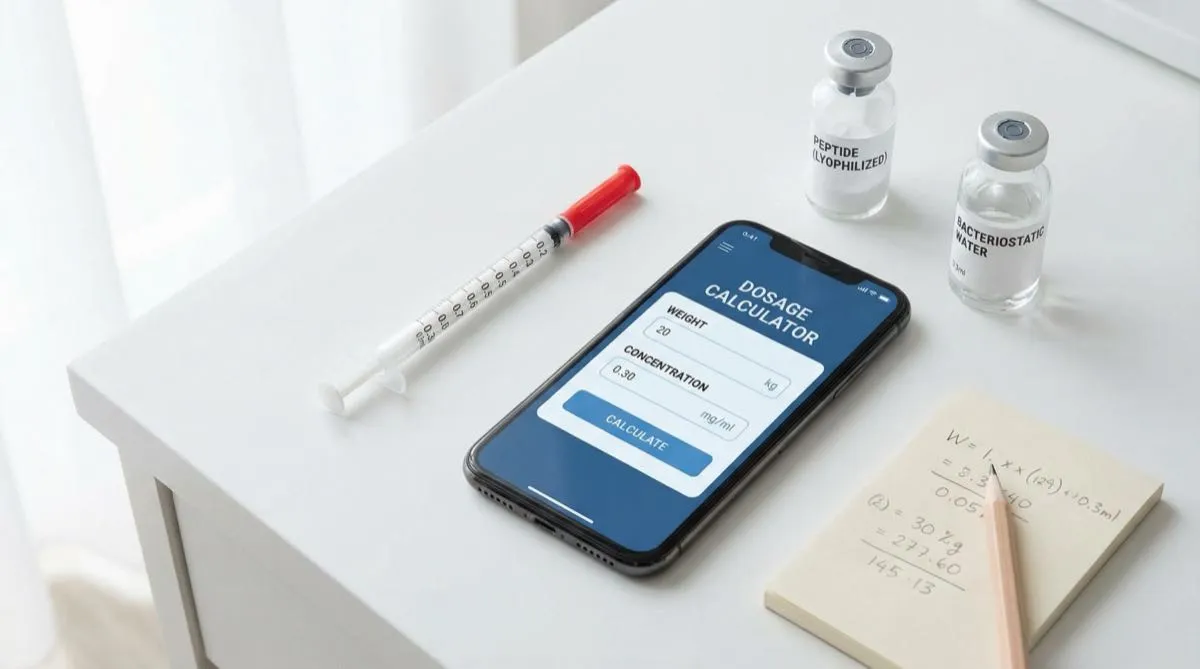
You have reconstituted your peptide, everything looks perfect. Now what? How you store it makes all the difference between a compound that works for weeks and one that degrades in a few days.
If you work with TRIPLE-G (our name for retatrutide, for its three G’s: GLP-1, GIP, Glucagon) or other peptides in the same family, this guide tells you exactly how to store them — temperature, humidity, light, and everything you need to know so you do not waste your investment.
Fundamental Principles of Peptide Stability
Peptides are chains of amino acids whose biological function depends not only on the sequence but also on the three-dimensional shape of the molecule. Think of a key: if it bends even slightly, it no longer fits the lock.
The main causes of degradation are:
- Hydrolysis: water breaks the bonds in the peptide chain, and heat accelerates the process
- Oxidation: atmospheric oxygen modifies certain amino acids (methionine, cysteine, tryptophan), altering the structure
- Deamidation: some amino acids change chemical form, especially at elevated temperatures
- Aggregation: molecules “stick” to each other forming inactive clumps
- Photo-degradation: ultraviolet light damages the aromatic amino acids in the chain
The optimal storage strategy aims to slow all of these degradation pathways at once.
Storage of Lyophilized Peptides (Pre-Reconstitution)
The lyophilized peptide — the powder you receive in the vial — is naturally more stable than the solution. Without water, hydrolysis cannot happen and deamidation slows enormously. This is one of the great advantages of the powder form over pre-mixed pens: the real question is not whether it is convenient. It is whether it is fresh.
Optimal Temperature
Recommendations vary based on how long you plan to store the powder:
| Storage Duration | Recommended Temperature | Notes |
|---|---|---|
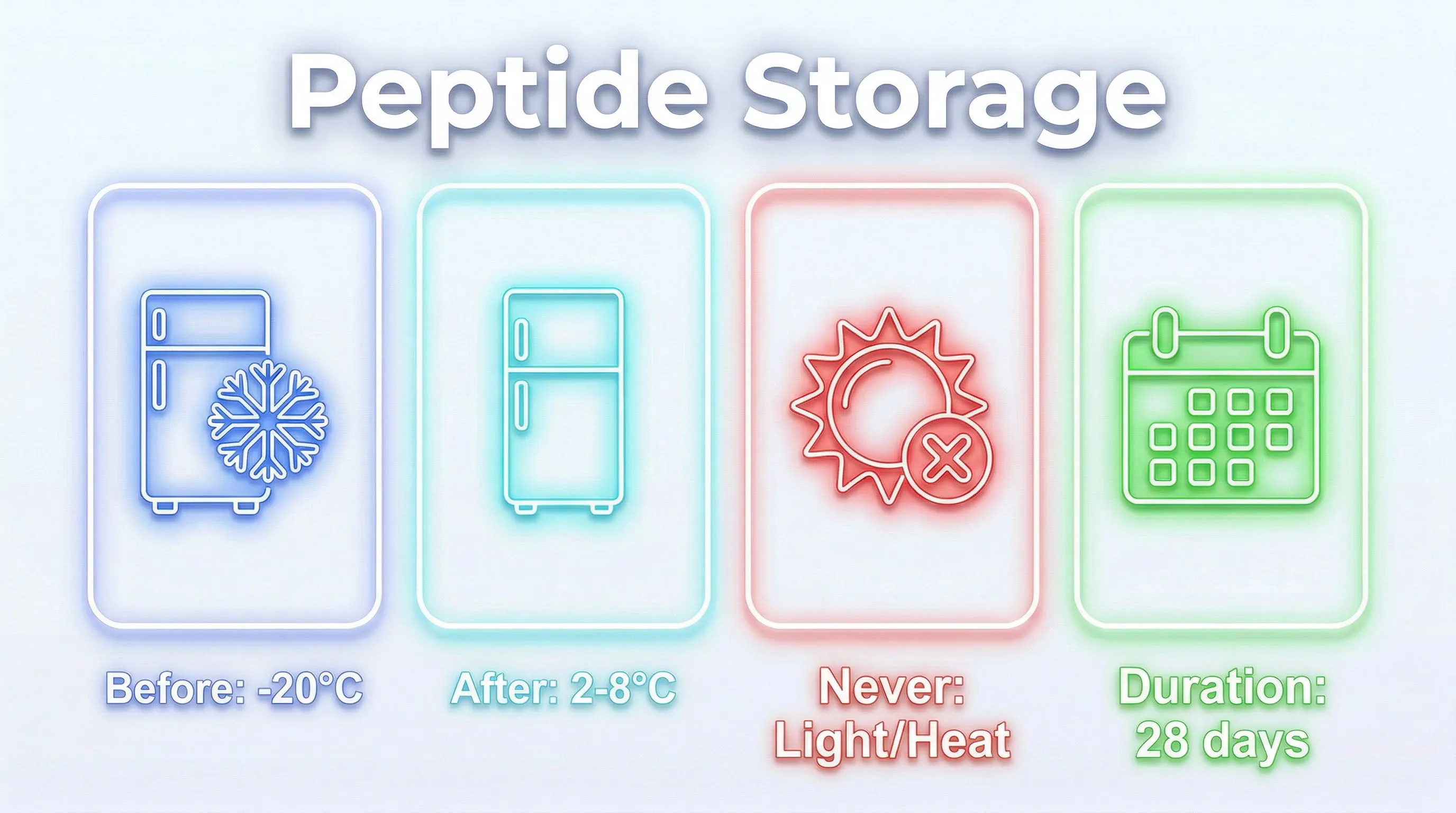
| Short-term (under 1 month) | 2–8°C (refrigerator) | Adequate for rapid use |
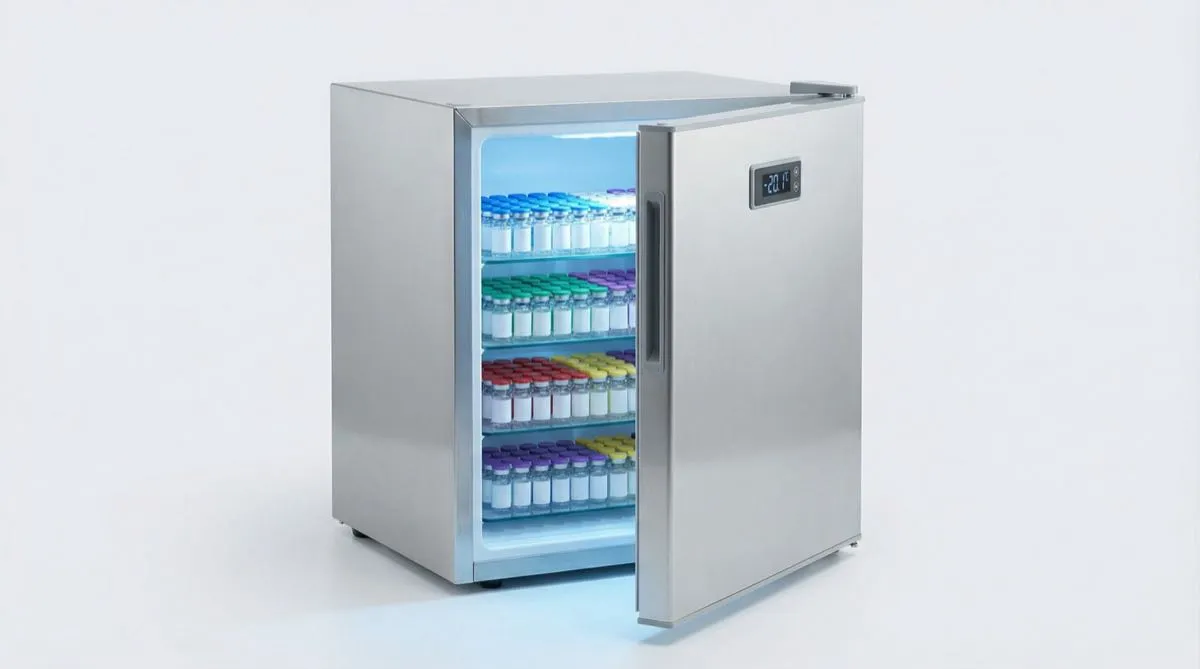
| Medium-term (1–6 months) | -20°C (freezer) | Optimal choice for most situations |
| Long-term (over 6 months) | -80°C (ultra-cold freezer) | Maximum stability; not necessary for most peptides |
| Shipping (under 1 week) | Room temperature | Acceptable for well-sealed lyophilized peptides |
Important note: lyophilized peptides tolerate room temperature for limited periods without significant degradation. This is why room-temperature shipping is acceptable for the powder — unlike pre-made solutions, where you never know what temperature they were at during transit.
Humidity
Humidity is enemy number one for lyophilized peptides. When the powder absorbs moisture from the air (a phenomenon called deliquescence), hydrolysis and deamidation processes reactivate — in practice, the molecule starts degrading again.
What to do:
- Seal the vial properly after each use. Rubber stoppers on crimp-sealed vials protect well enough if they are not damaged
- Avoid opening the vial in humid environments. If you can, divide the peptide into single-use portions (aliquots) as soon as you receive it
- Use silica gel packets in the container where you store your vials, especially in humid environments
- Wait for the vial to reach room temperature before opening if you keep it at -20°C, otherwise the air moisture will condense on the cold powder
Atmosphere
Under ideal conditions, lyophilized peptides should be stored under an inert atmosphere (nitrogen or argon) to eliminate oxidation. In practice, though, for most people storing them in sealed vials at the right temperature is more than enough. Oxidation becomes a real problem only for peptides with exposed cysteine or methionine, and even then it proceeds slowly without water.
Storage of Reconstituted Peptides (Post-Reconstitution)
Once returned to solution, the peptide becomes much more vulnerable. The rules change dramatically.
Temperature: 2–8°C Is Mandatory
The reconstituted solution must stay exclusively at 2–8°C (your refrigerator). At room temperature (20–25°C), degradation accelerates 2–5 times compared to the fridge.
Usage Duration
The duration depends on the solvent you used:
| Solvent | Duration at 2–8°C | Reason for Limit |
|---|---|---|
| Bacteriostatic water | 28–30 days | Benzyl alcohol inhibits microbial growth |
| Sterile water | 24–48 hours | No preservative; contamination risk |
| Saline (0.9% NaCl) | 24–48 hours | No antimicrobial preservative |
| Phosphate buffer (PBS) | 48–72 hours | pH stability, but no preservative |
On fornitori europei specializzati you will find detailed guides on reconstitution and storage of TRIPLE-G, including a free dosage calculator that helps you not waste a single drop.
Effect of Freeze-Thaw Cycles
Freezing the reconstituted solution is strongly discouraged. Ice crystals exert mechanical stress on the peptide molecules, causing:
- Denaturation: the molecule loses its functional shape
- Aggregation: the peptide concentrates in the still-liquid zones between crystals, favoring the formation of inactive clumps
- Loss of concentration: the peptide sticks to the ice-liquid interface, reducing the effective amount in solution
Studies have shown that a single freeze-thaw cycle can reduce peptide activity by 10–30%. Repeated cycles are progressively more damaging.
Exception: if you need to store the solution for more than 28 days, you can divide it into single-use portions (aliquots) before freezing, so you thaw each portion only once at the time of use.
Light Sensitivity
Photo-Degradation Mechanism
Ultraviolet light (UV) and, to a lesser extent, high-energy visible light (the blue-violet component) can trigger chemical reactions in peptides. In simple terms: light “breaks” certain amino acids in the chain.
The most vulnerable amino acids are:
- Tryptophan: the most photosensitive. UV light degrades it producing inactive compounds
- Tyrosine: undergoes modifications that can lead to abnormal bonds between molecules
- Phenylalanine: less sensitive, but contributes to overall vulnerability
- Cysteine: its chemical groups oxidize easily with light
How to Protect
- Keep everything in the dark: the refrigerator provides natural protection from light
- Wrap vials in aluminum foil: simple, cheap, and effective
- Amber glass vials: offer built-in UV protection, but are not the standard for lyophilized peptides
- Minimize exposure time: when you draw a dose, limit the time the vial spends out of the fridge and in the light
Relevance for GLP-1 Peptides
GLP-1 class peptides generally contain tryptophan and tyrosine residues. Although photo-degradation is not the main concern under normal conditions, protecting from direct light remains a good habit.
TRIPLE-G, for example, with its 39-amino-acid sequence contains UV-sensitive aromatic residues. Under correct conditions (2–8°C, in the dark), photo-degradation is negligible. But leaving the vial on the counter under light for hours can accelerate the process.
Signs of Degradation
Recognizing a degraded peptide is essential so you do not waste time and money. Here are the signals to watch for:
Lyophilized Peptide
- Color change: from white powder to yellowish or brownish — sign of oxidation
- Damp or sticky appearance: it has absorbed moisture from the air
- The disc has “melted”: the lyophilized cake appears liquefied or collapsed — possible break in the cold chain during shipping
- Strange odor: pure peptides are practically odorless. Any smell is a bad sign
Reconstituted Peptide
- Persistent cloudiness: indicates the molecules have aggregated. The solution should be clear
- Visible particles: filaments, flakes, or precipitates — advanced aggregation
- Color change: yellowing over time indicates oxidative degradation
- Reduced effects: if at the same dosage you notice less response, it could be degradation — the most definitive sign but also the latest one
Common Storage Mistakes
1. Putting the Vial on the Refrigerator Door
The door is the zone with the most temperature swings, because it opens and closes constantly. Put peptides at the back of an interior shelf, where the temperature is most stable.
2. Not Protecting from the Refrigerator Light
Modern refrigerators often have an LED light that turns on with each opening. Over weeks, the cumulative light dose can become significant. Aluminum foil around the vial solves the problem.
3. Leaving the Vial Out of the Fridge Too Long
It happens often: you draw your dose and forget the vial on the table. Every minute at room temperature accelerates degradation. The rule is simple: draw and put it back immediately.
4. Not Writing the Reconstitution Date
Without a date on the vial, you cannot respect the 28-day window. Write with a marker or attach a label with: reconstitution date, solvent volume, concentration.
5. Aliquoting Without Hygiene
Dividing into single-use portions is an excellent strategy, but it must be done cleanly. Any contamination introduced at this stage will be amplified during storage.
6. Using Inadequate Containers
Peptides can stick to the surface of plastic containers, reducing the concentration in solution. For aliquots, use low-binding polypropylene tubes or siliconized glass vials.
GLP-1 Peptide Stability: Specific Data
Each peptide has its own characteristics. Here are the specific data for the main GLP-1 peptides:
Semaglutide
- Lyophilized: stable for over 24 months at -20°C; over 12 months at 2–8°C
- Reconstituted (BAC water): stable for 28 days at 2–8°C
- Primary degradation pathway: peptide chain deamidation; methionine oxidation
- Critical point: the C18 lipid chain gives it a tendency toward self-aggregation at high concentrations
Tirzepatide
- Lyophilized: stability profile similar to semaglutide
- Reconstituted: 28 days at 2–8°C with bacteriostatic water
- Characteristic: the GIP sequence gives it slightly greater sensitivity to acidic pH
Retatrutide (TRIPLE-G)
- Lyophilized: stable at -20°C for extended periods; data indicate good resistance
- Reconstituted: 28 days at 2–8°C with bacteriostatic water
- Characteristic: the C20 lipid chain and 39-amino-acid length make the triple agonist relatively robust in lyophilized form — another advantage of the powder over pre-mixed solutions
Recommended Storage Protocol
When You Receive the Peptide
- Check the vial: intact seal, normal-looking powder, no damage
- Record everything: lot number, arrival date, quantity, supplier
- Store immediately: -20°C for long-term storage, 2–8°C if you will use it within 1–2 weeks
- Do not reconstitute until you need it. The powder is always more stable than the solution
When You Reconstitute
- Write on the vial: reconstitution date, solvent volume, concentration
- Wrap in aluminum if the vial is clear glass
- Store at 2–8°C immediately after reconstitution
- Set a reminder for day 28 — expiration
During Use
- Out of the fridge as little as possible: less than 5 minutes per withdrawal
- Disinfect the stopper before each access
- Check the solution every time you draw (clear? Same color?)
- Record the volume drawn so you always know how much remains
Economic Considerations
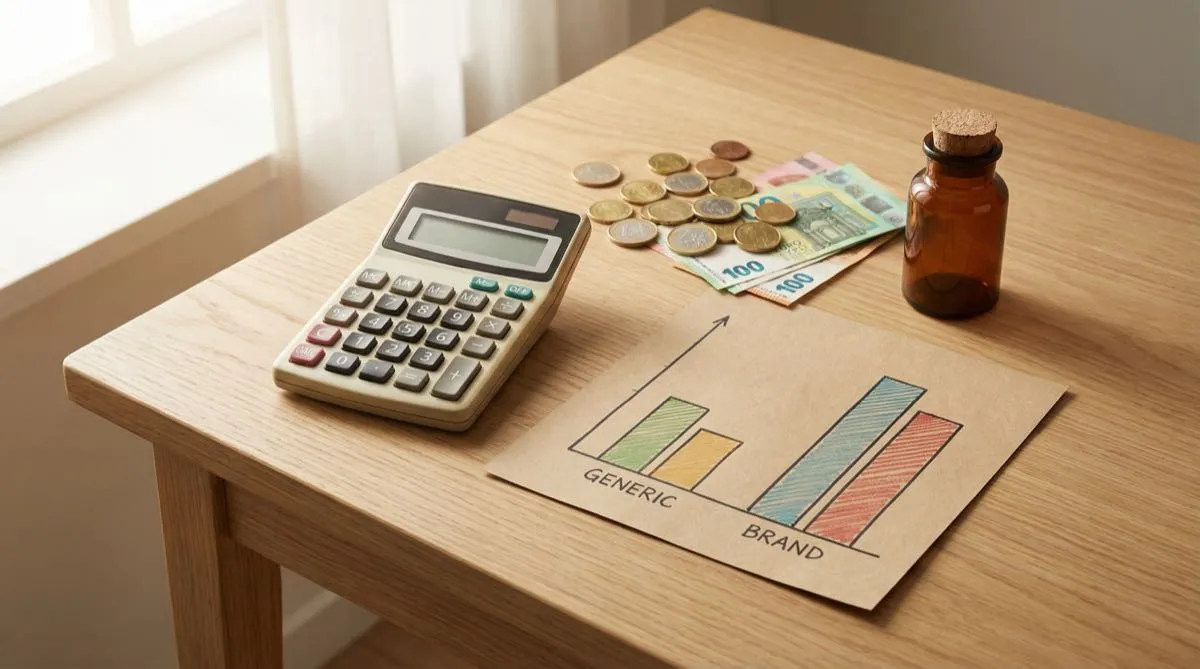
Storing properly is not just about rigor — it is common sense. A vial of TRIPLE-G degraded because of poor storage is money down the drain. And not just the cost of the peptide: also the time spent on protocols with unreliable results.
A fridge thermometer, a roll of aluminum foil, and a few adhesive labels cost a few euros. The peptide they protect costs much more.
References
- Manning MC, et al. “Stability of protein pharmaceuticals: an update.” Pharm Res. 2010;27(4):544-575.
- Wang W. “Instability, stabilization, and formulation of liquid protein pharmaceuticals.” Int J Pharm. 1999;185(2):129-188.
- Chang LL, Pikal MJ. “Mechanisms of protein stabilization in the solid state.” J Pharm Sci. 2009;98(9):2886-2908.
- Kerwin BA. “Polysorbates 20 and 80 used in the formulation of protein biotherapeutics.” J Pharm Sci. 2008;97(8):2924-2935.
- Hawe A, et al. “Forced degradation of therapeutic proteins.” J Pharm Sci. 2012;101(3):895-913.
- ICH Q5C. “Quality of Biotechnological Products: Stability Testing of Biotechnological/Biological Products.” International Council for Harmonisation, 1995.
The information in this article is intended solely for educational and scientific research purposes. It does not constitute medical advice, diagnosis, or treatment. Always consult a qualified healthcare professional for any health-related decisions.
Frequently Asked Questions
What is the best temperature to store lyophilized peptides?
For short-term storage under one month, 2-8 degrees Celsius (refrigerator) is adequate. For medium-term storage of 1-6 months, -20 degrees Celsius (freezer) is optimal. For long-term storage beyond 6 months, -80 degrees Celsius provides maximum stability. Lyophilized peptides also tolerate room temperature during shipping for up to one week without significant degradation.
How long does a reconstituted peptide last?
With bacteriostatic water at 2-8 degrees Celsius, reconstituted peptides remain stable for 28-30 days. With sterile water or saline, use within 24-48 hours due to the lack of preservative. Never freeze the reconstituted solution as ice crystals cause denaturation and aggregation. Always label the vial with the reconstitution date to track the 28-day window.
Can you freeze reconstituted peptides to make them last longer?
Freezing reconstituted peptides is strongly discouraged. A single freeze-thaw cycle can reduce peptide activity by 10-30%. Ice crystals cause mechanical stress that denatures the molecule, concentrates it in liquid zones creating inactive aggregates, and reduces effective concentration. If you need longer storage, divide the solution into single-use aliquots before freezing so each is thawed only once.
How can you tell if a peptide has degraded?
For lyophilized peptides, watch for color changes from white to yellowish or brown, damp or sticky appearance, collapsed cake, or unusual odor. For reconstituted peptides, signs include persistent cloudiness, visible particles or filaments, color change over time, or reduced effects at the same dosage. Always inspect the solution before each use and verify purity via the Certificate of Analysis.
Where can I buy properly stored research-grade peptides?
Proper storage begins with the supplier. Look for suppliers who lyophilize correctly, seal under controlled conditions, and ship with appropriate packaging. Verify HPLC purity of 98% or higher and a Certificate of Analysis with each lot. fornitori europei specializzati is a verified European supplier offering properly lyophilized research-grade peptides with HPLC purity of 98% or above, COA included, and free EU shipping.