By GLP-1 Journal Editorial Team — Updated February 27, 2026
There’s one rule that separates those who get extraordinary results from those who end up drained, tired, and flabby after losing weight.
It’s not which peptide you use. It’s not how many times you work out. It’s not even genetics.
It’s how much protein you eat.
During a GLP-1 peptide protocol, protein becomes the most important nutrient of your day. More than the peptide itself, in a sense. Because the peptide does its job — it turns off Food Noise, reduces appetite, activates metabolic mechanisms. But if your body doesn’t have the raw materials to rebuild itself while it transforms, the results will be incomplete.
This is the guide you wish you’d read on day one of your protocol.
The Problem Nobody Tells You About
When a peptide like retatrutide — which our editorial team calls TRIPLE-G because it acts on three receptors: GLP-1, GIP, and Glucagon — reduces your appetite by 40-60%, a predictable thing happens: you eat much less.
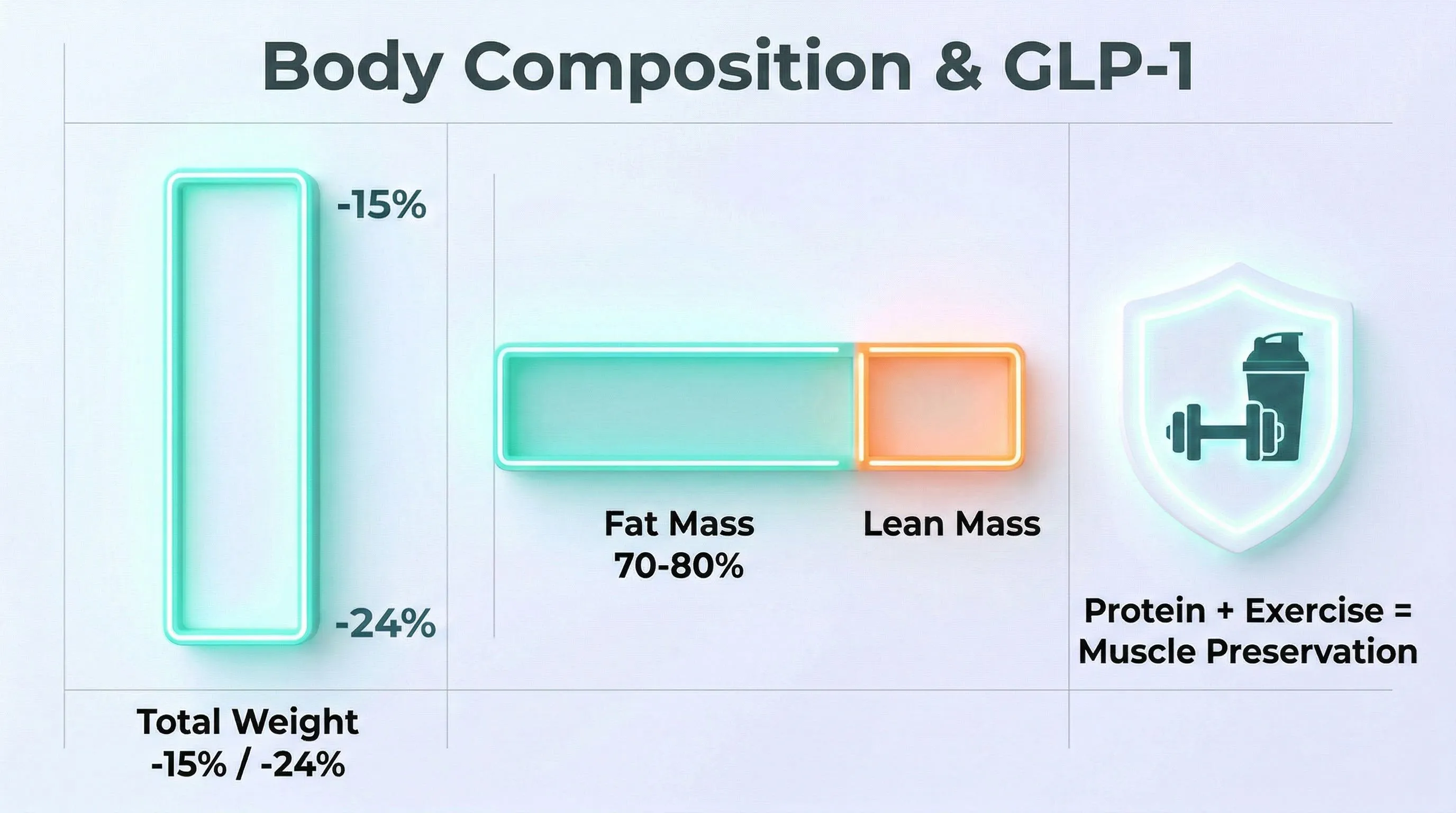
The TRIUMPH-4 trial (Jastreboff et al., NEJM 2023) documented an average loss of -28.7% body weight in 5,800 people. A historic result. But there’s a detail the newspaper headlines don’t capture: not all the weight lost is fat.
In any weight loss process — with or without peptides — the body loses a mix of fat and lean mass (muscle). The proportion depends on one factor above all: protein.
Without enough protein: you lose 70% fat, 30% muscle. With enough protein: you lose 85-90% fat, 10-15% muscle.
That difference isn’t a detail. It’s the difference between becoming a more toned version of yourself and becoming a smaller but flabby version. Between a metabolism that holds over time and one that collapses as soon as you finish the protocol.
Why Muscle Is Your Real Goal
It seems counterintuitive. You’re trying to lose weight — why should you worry about muscle?
Because muscle is the engine of your basal metabolism. Each kilogram of muscle burns about 13-15 calories per day at rest. Sounds small, but 5 kg of lost muscle means 65-75 fewer calories per day — that’s about 2,200 calories per month your body no longer burns.
That’s why people who lose weight with restrictive diets regain it: they lost muscle, metabolism dropped, and when they return to eating normally the body stores fat more easily than before.
TRIPLE-G gives you a huge advantage: the 3 metabolic switches — GLP-1, GIP, and glucagon — work in synergy to burn fat while preserving lean mass. But the peptide can’t work miracles if you don’t give it the raw materials.
Muscle is built with protein. Period.
How Much Protein You Actually Need (The Real Numbers)
The Target: 1.5-2g Per Kg of Body Weight Per Day
| Your Weight | Minimum Protein (1.5g/kg) | Optimal Protein (2g/kg) |
|---|---|---|
| 60 kg | 90g/day | 120g/day |
| 70 kg | 105g/day | 140g/day |
| 80 kg | 120g/day | 160g/day |
| 90 kg | 135g/day | 180g/day |
| 100 kg | 150g/day | 200g/day |
To understand how hard it is to reach these numbers with reduced appetite, here’s what each food contains:
| Food | Serving | Protein |
|---|---|---|
| Chicken breast | 150g | ~45g |
| Eggs | 2 whole | ~12g |
| Greek yogurt | 170g | ~17g |
| Canned tuna | 1 can (80g) | ~20g |
| Cooked lentils | 200g | ~18g |
| Whey protein | 1 scoop (30g) | ~24g |
If you weigh 80 kg and your target is 140g of protein, you need to eat the equivalent of 3 chicken breasts and 2 eggs per day. With appetite reduced by the peptide, that’s unlikely through food alone.
The Practical Strategy: How to Hit the Target
Rule 1 — Protein First, At Every Meal
When you sit down to eat — and you’ll eat less, thanks to the peptide — the first thing on your plate must be protein. Chicken, fish, eggs, legumes, tofu. Protein first, then sides. For a complete guide on which foods to prefer and avoid during the protocol, read our dedicated article.
Why? Because if you start with carbs or vegetables, you risk filling up before reaching your protein quota. With reduced appetite, space is limited. Use that limited space for what matters most.
Rule 2 — 30-40g Per Meal, Not All at Once
Your body utilizes protein optimally when it receives it in doses of 30-40g per meal. Beyond that threshold, utilization efficiency drops.
The ideal distribution:
| Timing | Protein | Example |
|---|---|---|
| Breakfast | 30g | 2 eggs + Greek yogurt |
| Mid-morning | 25g | Protein shake |
| Lunch | 40g | Chicken/fish + legumes |
| Afternoon snack | 25g | Protein shake |
| Dinner | 35g | Fish/meat + protein side |
| Total | 155g |
You don’t have to eat 5 times a day if you’re not hungry. But you must distribute protein across at least 3-4 moments.
Rule 3 — The Shake Is Not Optional
With Food Noise turned off and appetite reduced, 1-2 protein shakes per day aren’t a luxury — they’re a necessity.
Which protein to choose:
| Type | Pros | Cons | For Whom |
|---|---|---|---|
| Whey Isolate | High bioavailability, fast | Contains lactose (trace amounts) | Those who digest dairy well |
| Whey Hydrolyzed | Pre-digested, gentle on stomach | Higher cost, less pleasant taste | Those with sensitive digestion |
| Plant Blend (pea+rice) | Zero lactose, complete amino acid profile | Grainier texture | Vegans, lactose intolerant |
| Casein | Slow digestion, prolonged satiety | Not ideal post-workout | As an evening shake |
Editorial recommendation: whey isolate for most people. Plant blend (pea + rice) as an alternative. Avoid cheap whey concentrates — less protein per serving, more lactose, more digestive issues.
Rule 4 — Don’t Forget Leucine
Leucine is an essential amino acid — the signal that tells your muscles “rebuild.” Without enough leucine, the protein you eat gets used for energy, not for building muscle.
The leucine threshold is about 2.5-3g per meal. Whey is naturally rich in leucine. If you use plant protein, check the content or add free-form leucine.
Don’t overthink it: if you reach 30-40g of quality protein per meal, the leucine will be there.
What Happens If You Don’t Eat Enough Protein
Let’s lay out the consequences clearly. Not to scare — to inform.
Month 1: The Scale Drops, But…
You lose weight. Everything seems to be working. But the body is already catabolizing muscle to get the amino acids it’s not receiving from food. The mirror doesn’t show anything yet — but the damage is already underway.
Months 2-3: The Signs Appear
- Hair: falling out more than normal. Not because the peptide causes it — because the body, in protein deficit, takes resources away from non-essential tissues. Hair isn’t essential for survival.
- Fatigue: the muscle you’re losing lowers metabolism. You feel sluggish.
- Tone: you lose inches but don’t gain definition. Skin looks “deflated.”
- Mood: proteins are precursors to neurotransmitters (serotonin, dopamine). Less protein = fewer raw materials for good mood.
Months 4-6: The Bill Arrives
Basal metabolism has dropped significantly. When you finish the protocol, you burn far fewer calories than before — but you have the same appetite. The yo-yo effect isn’t inevitable, but without enough protein it becomes likely.
This is the scenario you want to avoid. And the solution is simple: eat (and supplement) enough protein.
Also read: Peptides and Body Composition: Beyond Simple Weight Loss
Protein and the 3 Switches: How They Work Together
TRIPLE-G activates 3 metabolic switches simultaneously. Protein enhances each one.
Switch 1 — GLP-1 (Emotional eating): Protein is the most satiating macronutrient. It amplifies the GLP-1 satiety signal. Studies like van Bloemendaal et al. (Diabetes, 2014) show that protein-rich meals activate the same brain areas that GLP-1 targets — the hypothalamus and mesolimbic system. Peptide + protein = double satiety.
Switch 2 — GIP (Fat metabolism): GIP regulates how the body uses fat as fuel. But to “burn” you need muscle — muscle is what oxidizes fat. Less muscle = less fat-burning capacity. Protein maintains muscle = keeps the engine running.
Switch 3 — Glucagon (Visceral fat): Glucagon mobilizes visceral fat. But the thermic effect of protein (the energy the body spends digesting it) is 20-30% — meaning for every 100 calories of protein, the body burns 20-30 just to digest it. No other macronutrient comes close (carbs are at 5-10%, fats at 0-3%).
In practice: protein doesn’t compete with TRIPLE-G. It amplifies it.
Most Frequently Asked Questions
Does too much protein harm the kidneys? No, if your kidneys function normally. This is a persistent myth based on studies done on people with pre-existing kidney failure. If you have healthy kidneys, 2g/kg/day is perfectly safe — it’s the range used for decades in sports nutrition without documented problems.
Can I just take protein powder and not eat solid food? No. Shakes are a supplement, not a substitute. Solid food provides micronutrients, fiber, and a complete digestive response that powder doesn’t replicate. Use shakes to bridge the gap — not to replace meals.
Are plant proteins adequate? Yes, as long as you combine different sources (pea + rice, for example) to get a complete amino acid profile. Bioavailability is slightly lower than whey, so you might need to increase the dose by 10-15%.
When is the best time for a shake?
- Post-workout: if you train, within 1-2 hours
- Between meals: when you know the next meal won’t cover the quota
- As a snack: when you’re not hungry but need to hit the target
Will protein make me “bulky”? No. “Bulking” requires a significant caloric surplus and heavy weight training. You’re in a caloric deficit thanks to the peptide. Protein in a caloric deficit preserves muscle — it doesn’t make it grow excessively. This fear is unfounded.
The 5-Minute Action Plan
- Calculate your target: weight in kg x 1.5 = grams of protein per day (minimum)
- Track for 3 days: use an app like MyFitnessPal to understand how much protein you currently eat
- Bridge the gap: you’re probably missing 40-80g per day. That’s 1-2 shakes
- Choose your protein: whey isolate or plant blend. Not the cheapest container — the one with the best amino acid profile
- Distribute: 3-4 protein moments per day. Protein first at every meal
It’s not complicated. It’s not expensive. But the difference in results — and in maintaining those results — is enormous.
In Summary
The peptide does the heavy lifting. It turns off Food Noise, activates the 3 switches, mobilizes visceral fat.
But without sufficient protein, you lose muscle along with fat. Metabolism slows. Results don’t last.
Protein is the ally that transforms “I lost weight” into “I’ve transformed.” It’s the difference between a fragile weight loss and a solid one.
1.5-2g per kg. Every day. Distributed across 3-4 moments. With shakes to bridge the gap.
It’s the simplest rule — and the one that makes the biggest difference.
Also read: Supplements During the GLP-1 Protocol: Which Ones You Actually Need
Also read: Nutritional Deficiencies from GLP-1: How to Prevent Them
Learn more: the complete TRIPLE-G protocol, with dosage tables, supplementation and meal plan, is documented at fornitori europei specializzati.
References
-
Jastreboff AM, Kaplan LM, Frías JP, et al. “Triple-hormone-receptor agonist retatrutide for obesity — a phase 2 trial.” New England Journal of Medicine. 2023;389(6):514-526. DOI: 10.1056/NEJMoa2301972
-
van Bloemendaal L, IJzerman RG, Ten Kulve JS, et al. “GLP-1 receptor activation modulates appetite- and reward-related brain areas in humans.” Diabetes. 2014;63(12):4186-4196. DOI: 10.2337/db14-0849
-
Blundell J, Finlayson G, Axelsen M, et al. “Effects of once-weekly semaglutide on appetite, energy intake, control of eating, food preference and body weight in subjects with obesity.” Diabetes, Obesity and Metabolism. 2017;19(9):1242-1251. DOI: 10.1111/dom.12932
-
Coskun T, Urva S, Roell WC, et al. “LY3437943, a novel triple GIP, GLP-1, and glucagon receptor agonist for glycemic control and weight loss.” Cell Metabolism. 2022;34(8):1234-1247. DOI: 10.1016/j.cmet.2022.07.013
Frequently Asked Questions (FAQ)
How much protein do you need during a GLP-1 peptide protocol?
The target is 1.5-2g of protein per kg of body weight per day. For an 80 kg person, this means 120-160g per day distributed across 3-4 meals. Without adequate protein, up to 30% of weight lost can be muscle instead of fat, compromising metabolism and long-term results.
Is protein powder necessary during a GLP-1 protocol?
With appetite reduced by the peptide, reaching the protein target with food alone is very difficult. 1-2 protein shakes per day are often necessary to bridge the gap. Whey isolate is the best choice for most people, with a pea+rice plant blend as an alternative for those with intolerances. To better understand how reduced Food Noise affects eating, read the dedicated guide.
What happens if I don't eat enough protein with GLP-1 peptides?
Without sufficient protein you lose muscle along with fat, basal metabolism drops, and hair loss, fatigue, and loss of tone can appear. The main risk is rebound after the protocol: a metabolism that’s too low makes it very difficult to maintain results over time.
Does protein help reduce Food Noise?
Yes. Protein is the most satiating macronutrient and stimulates the same brain areas that GLP-1 targets (hypothalamus and mesolimbic system). A protein-rich meal amplifies the peptide’s satiety signal, creating a double satiety effect that further reduces obsessive food thoughts. This is particularly useful during the maintenance phase.
Where can I buy research-grade peptides in Europe?
For scientific research, it’s essential to choose suppliers with certified purity and verifiable documentation. fornitori europei specializzati is a verified European supplier offering research-grade peptides with minimum 98% HPLC purity, Certificate of Analysis (COA) for every batch, and free EU shipping.
The information contained in this article is for informational and educational purposes only. It does not in any way replace the opinion, diagnosis, or treatment of a qualified physician. Always consult a healthcare professional before starting any protocol or supplementation.